<?xml version="1.0" encoding="utf-8"?>
<feed xmlns="http://www.w3.org/2005/Atom">
    <title>Unloosen</title>
    <link rel="alternate" type="text/html" href="http://www.unloosen.com/thestuff/" />
    <link rel="self" type="application/atom+xml" href="http://www.unloosen.com/thestuff/atom.xml" />
    <id>tag:www.unloosen.com,2005-04-10:/thestuff//2</id>
    <updated>2010-03-11T11:55:27Z</updated>
    <subtitle>Stories, Photos &amp; Commentary Skewed Absurd</subtitle>
    <generator uri="http://www.sixapart.com/movabletype/">Movable Type Pro 4.2-en</generator>

<entry>
    <title>Back to the Future Part II, reviewed by Joe Blevins and Craig J. Clark</title>
    <link rel="alternate" type="text/html" href="http://www.unloosen.com/thestuff/archives/2010/03/back_to_the_future_part_ii_rev.html" />
    <id>tag:www.unloosen.com,2010:/thestuff//2.622</id>

    <published>2010-03-11T11:45:09Z</published>
    <updated>2010-03-11T11:55:27Z</updated>

    <summary> &quot;There&apos;s something very familiar about all this.&quot; - BIFF TANNEN, AGED 77 Roger Ebert defined a sequel as &quot;a filmed deal,&quot; and it&apos;s amazing how accurately the truly odd Back to the Future Part II reflects that definition. The...</summary>
    <author>
        <name>Joe Blevins and Craig J. Clark</name>
        <uri>http://www.unloosen.com/control/mt-cp.cgi?__mode=view&amp;blog_id=2&amp;id=44</uri>
    </author>
    
        <category term="Movies" scheme="http://www.sixapart.com/ns/types#category" />
    
        <category term="Reviews" scheme="http://www.sixapart.com/ns/types#category" />
    
    <category term="craigandjoewatchmoviesyouveactuallyheardof" label="craig and joe watch movies you&apos;ve actually heard of" scheme="http://www.sixapart.com/ns/types#tag" />
    
    <content type="html" xml:lang="en" xml:base="http://www.unloosen.com/thestuff/">
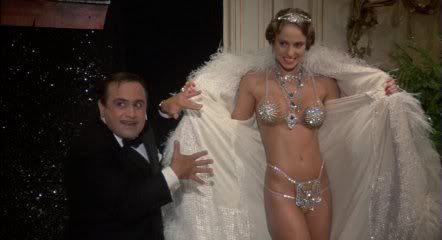
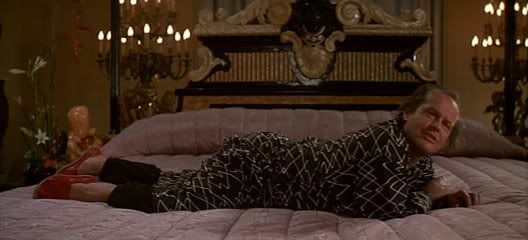
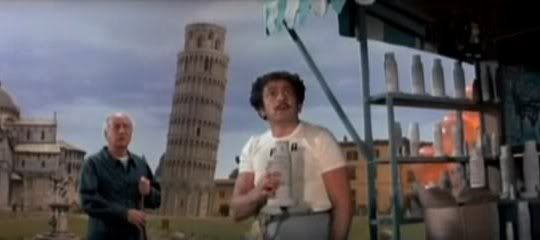
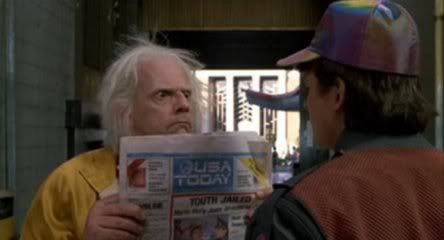
        <![CDATA[<p><IMG SRC="http://i799.photobucket.com/albums/yy272/craigjoeproject/05back1.jpg"><br />
<I>"There's something very familiar about all this."</I> - BIFF TANNEN, AGED 77</p>

<p>Roger Ebert defined a sequel as "a filmed deal," and it's amazing how accurately the truly odd <i>Back to the Future Part II</i> reflects that definition. The supplemental materials on the movie's DVD are surprisingly candid in laying out why the movie exists and why it took the form that it did. When the first <i>Back to the Future</i> was released in 1985, it was anything but a sure thing. The film's star, Michael J. Fox, was not a household name yet, and the film's co-creators (Robert Zemeckis and Bob Gale) had failed to attain mainstream success with their two previous films, <i>I Want to Hold Your Hand</i> and <i>Used Cars</i>. Worse yet, the Zemeckis/Gale-scripted <i>1941</i>, directed by Steven Spielberg, had been a financial disaster for Universal Pictures. So another Zemeckis/Gale comedy with Spielberg as producer was a risky proposition. In fact, the film could easily have turned out to be another embarrassing boondoggle for Universal.<br />
 <br />
But, of course, the first film was a massive worldwide hit, the top-grossing American film of 1985. A sequel was inevitable, and Universal informed Zemeckis and Gale that one would happen whether they were involved or not. So they were now "locked in," so to speak, as were most of the members of the first film's cast. Strangely, though, it was the holdout of one of the supporting players, Crispin Glover, that provided the catalyst for the sequel's plot in which his character (loveable nerd George McFly) is mysteriously killed off, creating another "time travel" problem for the heroes, Doc and Marty, to solve.</p>]]>
        <![CDATA[<p><i>Back to the Future</i>, it should be noted, was not designed as the first film in a franchise. The original film's ending, with Doc Brown taking Marty and Jennifer to the future in his flying car as a "TO BE CONTINUED" caption flashes on the screen, was written strictly as a joke. In fact, it's one of my favorite ways to end a comedy -- the classic "here we go again!" bit. It's a very satisfying way to conclude a comedy/fantasy film, knowing that the heroes are not going to rest but are going to embark upon yet another madcap adventure. There was really no need, other than financial, to revisit these characters or the Hill Valley setting. But if you're contractually obligated to revisit them, what the heck do you do with them? To their credit, Zemeckis and Gale came up with three different, potentially intriguing answers to that question and devote roughly one act of the final film to each of them.<br />
 <br />
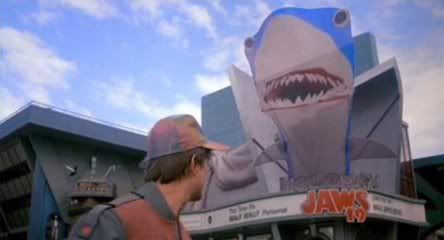
<b>1. Put Doc and Marty in the actual future.</b> Despite that pesky word "future" in the title, the <I>Back to the Future</i> trilogy is mainly about the past. The success of the first film all but single-handedly revived the "rock & roll nostalgia" sub-genre - which had been on the decline seven years after <i>Grease</i> - and soon the multiplexes and video stores were again teeming with oldies-laden films set during the 1950s and 1960s. But that same trend was again on the wane in 1989... or should I say the Bruce Wayne, because that was the year Tim Burton's designed-to-be-dark <i>Batman</i> definitively, perhaps permanently changed what a "blockbuster fantasy movie" was supposed to be. Gentle whimsy -- the original <i>Future</I>'s stock in trade -- was definitely out that year, which is perhaps why this sequel mainly plays as a harder-edged, more frantic action picture which barely takes time to pause and revel in its surroundings and instead zips from one calamity to the next. In any event, <I>BTTF2</i> devotes its first third to a thoroughly bizarre and somewhat off-putting sequence set in the Hill Valley of 2015. In the DVD supplements, Zemeckis admits that predicting the future is always a losing proposition -- even Stanley Kubrick was always wrong - so he and Gale mainly give this part of the film over to a variety of bizarre sight gags (hoverboards, self-lacing sneakers, double neckties, a 3D <i>Jaws</i> ad). This is also where the film begins to reveal itself as an almost surrealist parody of its predecessor, giving us grotesque and/or upsetting parodies of familiar scenes from the first film. Example: remember that funny, old-timey Texaco station from the previous movie? <i>Well, now it's staffed by sleek, vaguely threatening-looking robots! Zing!</i> And remember that classic showdown with Biff in the diner? <i>Well, now the diner is a gaudy 1980s-nostalgia-themed cafe where the "waiters" are Max-Headroom-ized versions of Ronald Reagan and Michael Jackson! And Biff has a grandson, Griff, who looks and talks just like him, only much louder! Nutty, right?</i> Overall, though, I was glad that the movie's version of the future is ostensibly cheerful, closer to <I>Futurama</i> than <i>Blade Runner</i>.<br />
 <br />
Unfortunately, the "future" part of the movie also spends some time at the depressing homestead of Marty and his family, where everybody mainly mills around in ugly and unconvincing old-age makeup amidst the various items of blatant product placement. The dialogue here is actually some of the movie's worst, as the characters work overtime to squeeze in crucial bits of plot exposition for us to overhear so we know what the hell is going on. The main point of all this is gimmickry for its own sake: the filmmakers have cast Michael J. Fox in multiple roles so that we can watch him interact with various versions of himself on-camera. It's not surprising that some of this sequence, expensive and complicated as it is, wound up on the cutting room floor. Weirdly, the only thing I really enjoyed in this part of the film was the way Fox played the older Marty as a hoarse-voiced, washed-up loser who whimpers pathetically as he is fired from his job via a big-screen TV while the news of his dismissal spews from several gadgets at once. It's like the whole house is ganging up on Marty at that point.<br />
 <br />
Oh, and before we leave this part of the film, I want to give the movie some credit for taking baby steps toward gender equality. Like his ancestors, Griff has a gang of sycophantic thugs around him, but this time one of them is a girl. I liked that. But, anyway, on to the next section of the film.<br />
 <br />
<b>2. Give us a nightmare version of the Hill Valley setting.</b> Again being surprisingly candid, Bob Gale admits on the <i>BTTF2</i> DVD that taking the story into the future was a logical and narrative mistake. You don't have to travel into the future to change it. Our destinies are ostensibly under our control, so we just have to try to live our lives so that those terrible outcomes never come true. If one of the real underlying problems is Marty's insecurity -- he can't stand being called "chicken" -- maybe he should just get some counseling or something instead of scampering willy-nilly through history , diddling with the space-time continuum to fix his and his relatives' various screw-ups. One could imagine an increasingly-lazy Marty relying on the DeLorean <i>every</i> time he goofed up. ("Damn, forgot to DVR <i>America's Next Top Model</i>. Better fire up the Flux Capacitor.")<br />
 <br />
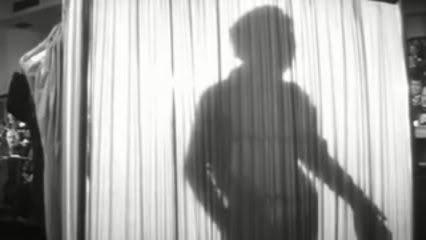
The middle of <i>BTTF2</i> shows us the negative fallout of Doc and (especially) Marty's impetuousness. They return to 1985, only to find themselves in a hellish alternate reality (called "1985-A" by the filmmakers) in which Biff is a multi-millionaire mogul married to Marty's mother, Lorraine, while Marty's father, George, is dead, having been murdered in 1973. This entire section of the film plays out like an extrapolation of the "Pottersville" sequence from <I>It's a Wonderful Life</i>. (Wow. That's the second time in this project I've had to reference <i>It's a Wonderful Life</i>.) Like George Bailey, Marty has inadvertently created a dark parallel timeline in which a charming small town has basically been turned into a dystopian Las Vegas (Hill Valley instead of Bedford Falls), the corrupt villain is in charge and wields unlimited power (Biff instead of Mr. Potter), and the sweet but kooky sidekick guy has been committed (Doc Brown instead of Uncle Billy). Weirdly, Zemeckis even films Michael J. Fox the way Frank Capra filmed Jimmy Stewart. Both Stewart and Fox have a tendency to walk right up to the camera at crucial moments as they register how badly they've messed things up. Again, the filmmakers use this sequence to give us weird parodies of scenes from the first film. Remember when Marty was waking up and heard his mother Lorraine's voice and thought he was back "home" again? <i>Well, now Lorraine has huge fake breasts and looks like a beat-up old whore, and they all live in a place which looks like it was decorated personally by Tony Montana! Pow!</i><br />
 <br />
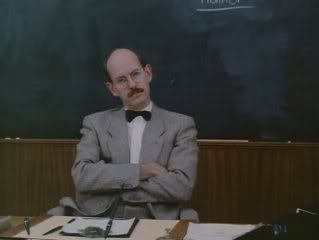
This second section of the film must've come as a shock to fans of the first film, as it more or less takes everything that was endearing about the original and vomits on it, but I admired it for its audacity and willingness to risk being offensive and alienating. There are some very funny things going on in the edges of the film as well. I enjoyed, for example, how Biff's gang from the 1950s have become his entourage in the 1980s, and how one of them (Billy Zane) has taken to wearing a cowboy hat as an affectation. And I laughed aloud -- for the only time during what is essentially a comedy -- during a scene which revisits Marty's old principal, Mr. Strickland, and finds him as a Rambo-like urban warrior taking on his hated "slackers" with a machine gun.<br />
 <br />
Getting back to the plot, Marty and Doc eventually realize the problems of "1985-A" can be traced back to the movie's #1 McGuffin -- <i>Gray's Sports Almanac</i>, a book of sports statistics which fell into Biff's clutches and allowed him to become rich and powerful, thus destroying the future. So the film enters its final -- and, to its credit, best -- stage.<br />
 <br />
<b>3. Revisit the first film from another angle.</b> During this portion of the film, Doc and Marty travel back to 1955 to prevent the 2015 Biff from giving the sports almanac to the 1955 Biff. If you could parse that previous sentence at all, it's a cinch that you've seen the first <i>Back to the Future</i>. It should be mentioned that <i>BTTF2</i> is a sequel which demands that its audience be thoroughly familiar with the plot of the original, not just the basic premise but the scenes and characters, too, down to fairly minute detail. Some sequels are completely comprehensible to newcomers; one needn't see every James Bond film to get the gist of the character. But a movie like <i>BTTF2</i> relies very heavily on what the experts call "inter-textual dialogue," and never is this more true than in the third act, in which Doc and Marty are basically creeping around in the margins of the first film, trying to remain just out of sight while alternate versions of themselves are just a few feet away, wrapped up in what <i>they</i> think is the real storyline. I'm getting a bit dizzy just thinking about all of this.<br />
 <br />
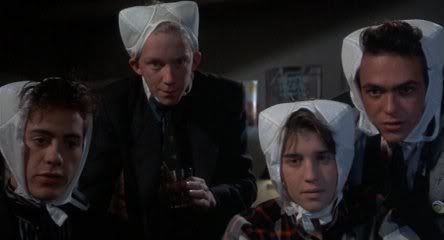
On the DVD, Zemeckis said it was this aspect of the story which interested him the most, and frankly it's what interested <i>me</i> the most as well. For one thing, it allows the film to ditch the horrendous makeup prosthetics of the first two acts, and it gives us a chance to see some more of the 1955 Hill Valley that we hadn't seen before. I liked getting a glimpse of Biff's home life, where he lives with his truly awful grandmother and menaces the small children in his neighborhood. (God bless the filmmakers for not dressing Thomas F. Wilson up in drag and having him play "Grandma Biff.") As noted previously, I'm always on board for more material with the mean principal, Mr. Strickland, so I was glad to have a scene of him drinking alone in his office during the famous Enchantment of the Sea Dance, secretly drowning his misery in the sauce and oblivious to the fact that rock & roll is being invented right next door. Above all, I loved the way this section of the film reached its mysterious and almost spooky apex, with Doc Brown seemingly obliterated by a lightning bolt and a stranded Marty -- alone on a rainy night in the middle of nowhere -- being suddenly visited by a trenchcoat-wearing Joe Flaherty, a very odd deus ex machina indeed. Of course, the film kind of fumbles the ball in the last few minutes by including a trailer for <i>Part III</i> before the closing credits, but even here I appreciated the opportunity to watch the members of ZZ Top do that thing where they spin their instruments around in perfect synchronicity. Damn, that always looks cool.<br />
 <br />
I have to say that revisiting <i>Back to the Future Part II</i> for this project was generally a rewarding experience. The film is certainly one of the more idiosyncratic sequels ever made, and though it's not always appealing -- and, indeed is often deliberately appalling -- I was not bored by it. I was actually surprised at how frantic it was and how much there is actually going on in this film. I'd like to file <i>BTTF2</i> alongside <i>Gremlins 2: The New Batch</i> and <i>Bill & Ted's Bogus Journey</i> in the small but noble category of meta-fictional parodies masquerading as sequels.<br />
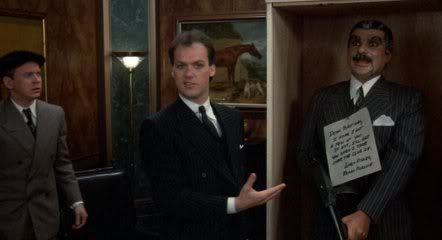
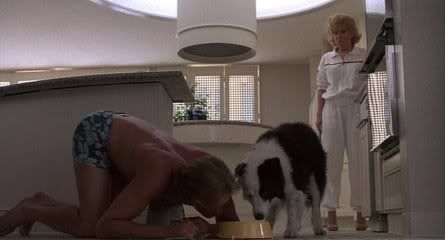
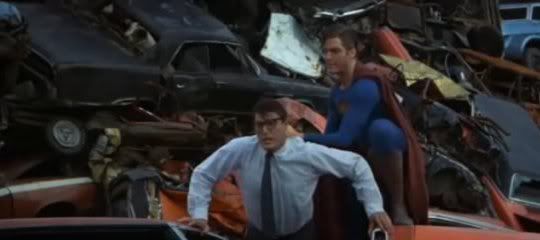
<IMG SRC="http://i799.photobucket.com/albums/yy272/craigjoeproject/05back2.jpg"><br />
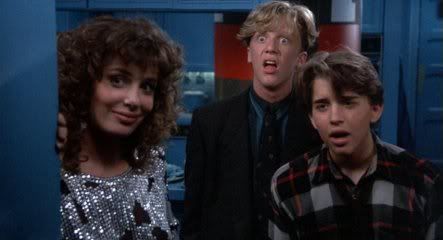
All right, you can do that, Joe. Me, I haven't been tempted to re-watch <I>Bogus Journey</I> since it was in theaters (although I have read the comic book adaptation since it was written and drawn by Evan Dorkin, creator of Milk and Cheese and freelance writer on <I>Space Ghost Coast to Coast</I> and <I>Yo Gabba Gabba</I>), and I probably wouldn't have given this film a second look, either, if you hadn't suggested it for this series. This is partially due to how unpleasant the middle section is (and it sure hasn't aged well, as you've pointed out), but it mostly stems from the feeling that one can't watch <I>Back to the Future Part II</I> without immediately following it with <I>Part III</I> so that the story can actual resolve itself. And if I can't seem to block out the four hours required to watch <I>Gone With the Wind</I> (a film that continues to elude me after all these years), I'm sure as heck not going to do that for two-thirds of the trilogy that practically defined the concept of diminishing returns for my 16-year-old self. This is not to say that the <I>Back to the Future</I> series ended on a bad note -- <I>Part III</I> went a long way toward washing away the bad taste that <I>Part II</I> had left in my mouth -- but neither of the sequels ever struck me as really <I>necessary</I>. I dutifully saw them as part of family outings, but between this film and <I>Ghostbusters 2</I>, 1989 was the year of the mercenary sequel that almost but didn't quite taint the sanctity of the original in my mind.<br />
 <br />
Speaking of having things contaminated, I'd like to say a few words about DVD menus and the people who create them. Now, I realize the perception is that most people who purchase catalog titles like the <I>Back to the Future</I> trilogy on DVD have already seen the movies in question, but is it really a good idea to include a montage of scenes from the film, including some major plot points, <I>including the ending of the film</I>, on the main menu? Surely it crossed their minds that people who were completely new to the series would sit down one day to watch it, presumably right after watching the first film for the first time. Did they really think these people wanted to have major plot points, <I>including the ending of the film</I>, spoiled for them? I guess they must have.<br />
 <br />
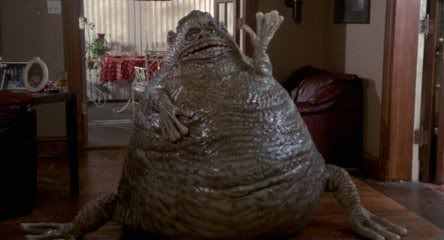
Anyway, getting back to the film, it hits an unavoidable speed bump right out of the gate owing to the replacement of Claudia Wells, who played Marty McFly's girlfriend in the first film, with Elisabeth Shue. This required Michael J. Fox and Christopher Lloyd to replay the original ending verbatim with the new Jennifer, but Lloyd's performance is so erratic (his delivery of the iconic line "Something's gotta be done about your kids" is especially off) that it's a major distraction. Now, I understand that actors aren't necessarily going to use the same exact inflections from take to take (especially ones that are done four years apart), but VCRs were so ubiquitous in the latter half of the '80s that the filmmakers must have realized that people would have re-watched the original multiple times over and thus committed the scene to memory. (As a matter of fact, as Joe points out, they were pretty much banking on that.) It's not like <I>Pulp Fiction</I>, in which Amanda Plummer's Honey Bunny delivers her "Nobody move" line differently at the beginning and end of the film. So much happens in between that you probably won't notice until the second or third time you watch it. With this film, though, if you're as much of a <I>Back to the Future</I> nut as Gale and Zemeckis hoped you would be, you can't help but pick up on it right off the bat, which means instead of wondering what's going to happen when Doc takes Marty and Jennifer to the year 2015, you're thinking, "What's wrong with Christopher Lloyd? Doesn't he know how to say his own lines?"<br />
 <br />
Moving on, the movie plops us down in 2015 (which, it should be said, is only five years away, or as Roland Emmerich has clearly shown us, three years after the world comes to an end) and immediately Gale and Zemeckis have Doc Brown knock Jennifer out for asking too many questions about her own future. Because when you're a scientist with a time machine the last thing you have <I>time</I> for is to pull over somewhere and take 15-20 minutes to explain things to your assistant's girlfriend. What it really comes down to, I think, is that Gale and Zemeckis were stuck with Jennifer in the DeLorean because she was there at the end of the first film and when they started working on the sequel they realized they had no idea what to do with her in the future. Pretty inconvenient, right? Zap! Problem solved!<br />
 <br />
With Jennifer out of the way, Doc fills Marty in on his plan (he's to impersonate his doofus of a son, Marty McFly Jr., and refuse to take part in a robbery) and sends him off into the bustling town square of the future Hill Valley with the admonition that he shouldn't look at anything or interact with anybody. Of course, movies are all about looking at things, so Marty ignores the Doc's instructions and marvels at the electronic billboards, including the extremely interactive one for <I>Jaws 19</I> at the Holomax. Now, anybody who saw <I>Jaws the Revenge</I> in 1987 knew there was no chance of a <I>Jaws 5</I>, let alone a <I>19</I>, but with the proliferation of IMAX theaters and the recent resurgence of 3-D movies, the idea of a hologrammatic film experience isn't so much of a stretch these days. Marty's also drawn to the window of an antique shop which, in addition to highlighting the pivotal sports almanac, also features a Roger Rabbit doll (a neat in-joke since that was Zemeckis's previous film) and a quaint-looking Macintosh "biege toaster." He then has his proscribed run-in with Griff (whose entire role can be summed up by the way he says, "Since when did you become the physical type?") and one McFly family disaster is avoided only for another to be waiting in the wings.<br />
 <br />
This second disaster comes in form of a "like father, like son" moment where Marty McFly Sr. (who is the fourth Michael J. Fox we see in the film -- I guess he was trying to one-up Eddie Murphy after <I>Coming to America</I>) fails to back down from an illegal business deal dangled in front of him by a colleague named Needles (a character played by an unrecognizable Flea whose importance to the story isn't revealed until the closing moments of the next film) and is subsequently terminated by his unforgiving Japanese employer, who tells him to "Read my fax." Yes, it's 2015 and people still send faxes, but this is easy to forgive because it's actually important for events in the <I>Back to the Future</I> movies to have a paper trail. After all, how else will we and the characters know that history has been changed if newspaper headlines, matchbooks and other printed media don't magically change in front of our eyes? (Of course, the payoff for the fax likewise doesn't come until the end of <I>Part III</I>, but that was released in the spring of 1990 so it's out of our purview.)<br />
 <br />
Since both sequels were written and produced simultaneously (a practice that was later repeated with <I>The Matrix</I> and <I>Pirates of the Caribbean</I> movies), there are a number of other things that are set up in <I>Part II</I> that don't pay off until <I>Part III</I>. One is Doc's declaration that the Old West is his favorite time period and that he wants to give up time travel and explore that other great mystery, women. Another is a passing reference to Buford "Mad Dog" Tannen, gunslinging ancestor to Biff in a video Marty sees upon his return to the 1985 that has been corrupted by Biff's evil influence. And finally there's the scene from <I>A Fistful of Dollars</I> that Biff watches with much amusement, little realizing that his forebear had a similar encounter with somebody posing as "Clint Eastwood" (just as Marty passed himself off as "Calvin Klein" in the first movie).<br />
 <br />
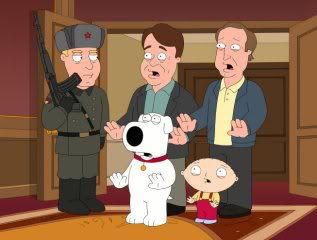
I tend to agree with Joe that the film picks up considerably when Doc and Marty return to 1955 to set things right and prevent all sorts of calamities that will befall them and their loved ones. Accordingly, there isn't a whole lot for me to say about it that Joe hasn't already covered, but I do want to point out the Travel Service sign in the background of some of the shots that trumpets "10 Days in Cuba!" (This neatly echoes the billboard in 2015 that invites travelers to "Surf Vietnam!" -- itself a clear reference to <I>Apocalypse Now</I>, which had been co-written by Zemeckis and Gale's <I>1941</I> co-writer John Milius.). And I quite like Joe Flaherty's walk-on as the ominous Western Union man, which he reprised almost word-for-word at the end of <I>Family Guy</I>'s second extended <I>Star Wars</I> parody, <I>Something Something Dark Side</I>, a take-off on <I>The Empire Strikes Back</I>, the gold standard for middle sequels that end on a cliffhanger. Which reminds me...<br />
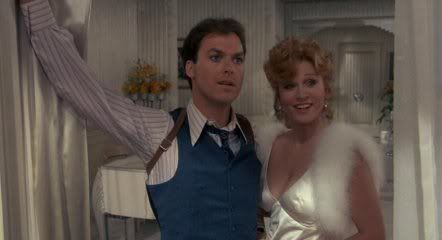
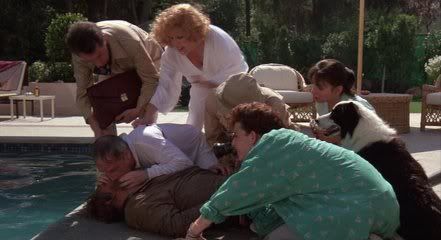
<IMG SRC="http://i799.photobucket.com/albums/yy272/craigjoeproject/05back3.jpg"><br />
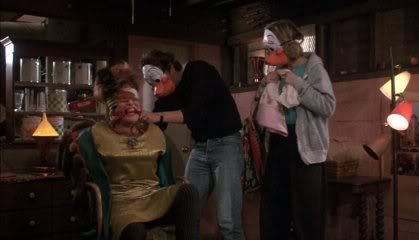
<B>Next up:</B> The third part of a blockbuster franchise that's not this one.</p>]]>
    </content>
</entry>

<entry>
    <title>Spies Like Us, reviewed by Craig J. Clark and Joe Blevins</title>
    <link rel="alternate" type="text/html" href="http://www.unloosen.com/thestuff/archives/2010/02/spies_like_us_reviewed_by_crai.html" />
    <id>tag:www.unloosen.com,2010:/thestuff//2.621</id>

    <published>2010-02-25T22:15:07Z</published>
    <updated>2010-02-25T22:18:25Z</updated>

    <summary> I don&apos;t think I&apos;m making any kind of an Earth-shattering revelation when I say that I was a comedy junkie for most of the &apos;80s. I didn&apos;t distinguish between good comedy or bad comedy, high or low humor; if...</summary>
    <author>
        <name>Craig J. Clark and Joe Blevins</name>
        <uri>http://www.unloosen.com/control/mt-cp.cgi?__mode=view&amp;blog_id=2&amp;id=45</uri>
    </author>
    
        <category term="Movies" scheme="http://www.sixapart.com/ns/types#category" />
    
        <category term="Reviews" scheme="http://www.sixapart.com/ns/types#category" />
    
    <category term="craigandjoewatchmoviesyouveactuallyheardof" label="craig and joe watch movies you&apos;ve actually heard of" scheme="http://www.sixapart.com/ns/types#tag" />
    
    <content type="html" xml:lang="en" xml:base="http://www.unloosen.com/thestuff/">
        <![CDATA[<p><IMG SRC="http://i799.photobucket.com/albums/yy272/craigjoeproject/04spies.jpg"><br />
I don't think I'm making any kind of an Earth-shattering revelation when I say that I was a comedy junkie for most of the '80s. I didn't distinguish between good comedy or bad comedy, high or low humor; if it meant to be funny, I would watch it. This is why, in addition to the collective works of Zucker-Abrahams-Zucker, I've also seen movies like <I>Morgan Stewart's Coming Home</I> multiple times and <I>Johnny Dangerously</I> was considered must-see viewing in the Clark household whenever it came on television, which was often. ("You shouldn't hang me on a hook, Johnny. My father hung me on a hook once. <I>Once!</I>") The holy grail for me, though (until I saw <I>Monty Python and the Holy Grail</I>, that is), was just about any film that starred an alumnus of <I>Saturday Night Live</I> -- despite the fact that I was too young to stay up and actually watch <I>Saturday Night Live</I> at the time. The ones that I gravitated to the most were Dan Aykroyd, John Belushi, Chevy Chase and Bill Murray, the breakout stars of the original cast who had gone on to great success (individually or in various pairings) in films like <I>Animal House</I>, <I>The Blues Brothers</I>, <I>Caddyshack</I>, <I>Stripes</I>, <I>National Lampoon's Vacation</I>, <I>Trading Places</I> and <I>Ghostbusters</I>. Sure, not all the movies they made were gems (<I>Modern Problems</I>, anyone? If not, would you prefer a house call from <I>Doctor Detroit</I>?), but I watched them regardless. As long as they made me laugh once or twice, I wasn't too particular.<br />
 <br />
If I respected any one of them more than the other four, it was definitely Dan Aykroyd, largely because he had a hand in writing many of the films he was in, which I felt gave him a leg up over the likes of Chevy Chase, who seemed to be content to do whatever happened to come his way. (This is how a misfire like <I>Under the Rainbow</I> happens.) When the two of them teamed up for 1985's <I>Spies Like Us</I> (which Aykroyd conceived with the original intention of co-starring with Belushi), I was delighted to finally see how they would play off each other. (I didn't get to see any of their work together on <I>Saturday Night Live</I> until years later, so as far as my 12-year-old mind was concerned, <I>Spies Like Us</I> was the first meeting of their comedic minds.) And while I had yet to become a full-blown auteurist, I was aware that the director, John Landis, had also been the guiding force behind <I>Animal House</I>, <I>The Blues Brothers</I>, <I>Trading Places</I> and the first segment of <I>Twilight Zone: The Movie</I> (the prologue for which had featured Aykroyd). In short, I was ready-made to love <I>Spies Like Us</I> and love it I did. I even bought the 45 of Paul McCartney's theme song, which in all fairness shouldn't be considered an indication of its quality. After all, for a time I was also the proud owner of the single "City of Crime" from the movie <I>Dragnet</I>. (I'm sure that's something Tom Hanks would like to wish out of existence.)</p>]]>
        <![CDATA[<p>Anyway, like a surprising number of '80s comedies -- in particular those spoofing the spy business -- <I>Spies Like Us</I> starts off with a very, very, very, very, very, very, <I>very</I> serious scene that sets the plot in motion before we're introduced to our would-be heroes. In this case, high-level intelligence operatives Bruce Davison and William Prince -- along with General Ripper-ish military men Steve Forrest and Tom Hatten -- are sent secret satellite photos of the Soviet ICBM site that they plan on hijacking for their own underhanded purposes. (There's a nifty comic touch where the hapless courier carrying the print-outs has to be locked in a closet before they will open the briefcase that's handcuffed to his wrist, but apart from that the scene is played more or less straight.) Then and only then do we get to meet our stars: the wisecracking slacker (Chase) goofing off at the State Department and the uber-geek (Aykroyd) toiling away in the bowels of the Pentagon. Watched over by then-president Ronald Reagan (who actually receives a screen credit at the end of the film), both are informed that they are due to take the foreign service examination the next day, which puts them on a collision course with wackiness as they both arrive late for the test, which is overseen by humorless monitor Frank Oz. After Chase is caught flagrantly cheating and the two of them cause a major disturbance, they're hand-picked by Davison and Prince to receive training as GLG-20's and be sent out into the field as soon as possible.<br />
 <br />
If I had to pick one reel that encapsulates the essence of the big-budget comedies of the mid-'80s, it would have to be <I>Spies Like Us</I>'s training sequence, in which Chase and Aykroyd are put through their paces by a stone-faced Bernie Casey while a tight-lipped Matt Frewer (post-<I>Crimson Permanent Assurance</I>, pre-<I>Max Headroom</I>) looks on. As long as it's content to force them to jump into a pool of muck to avoid getting machine-gunned to death, test their G-force threshold, or strap them into a wingless glider that immediately plummets off its perch and crashes to the ground, <I>Spies Like Us</I> is a joy to behold and the obscene amount of money that it took to make (just look at all the extras doing their exercises in the background of every shot or try to count the number of explosions that go off during the obstacle course scene) seems utterly worth it. Once the two of them are dropped into the Pakistani desert, though, the movie becomes a lot less sprightly, even if this is the part of the film that features Terry Gilliam's juicy cameo (as a Swiss doctor working for the U.N.) and introduces the main love interest, Donna Dixon (who was soon to be Mrs. Dan Aykroyd). This is also the point where the film makes its debt to the Bob Hope/Bing Crosby "Road" pictures of the '40s plain by having a golf ball land in the middle of their tent, followed by Hope who asks if he can play though and gets one parting shot ("Doctor, doctor... Glad I'm not sick.") on his way out.<br />
 <br />
The main problem with this stretch of the film (apart from the fact that it takes place in a part of the world that has much different associations for viewers today than it did a quarter century ago) is that it isn't long before the story gets bogged down in the serious plot again when it turns out that Dixon and her partner (played by <I>Brazil</I> co-writer and supporting player Charles McKeown) are the real GLG-20's that Chase and Aykroyd are supposed to be decoys for. After they completely botch a simple appendix operation while trying to pass themselves off as surgeons, they get in touch with their superiors who send them across the border into Russia, where they're weighed down by cumbersome (but funny-looking) winter outfits and things pick back up when Chase is captured by KGB and Aykroyd has no choice but to rescue him. (My favorite moment: a live grenade lands in Chase's lap and he asks what it is. Aykroyd cries out, "You don't want it!" and miraculously the gunfire ceases long enough for Chase to casually stand up and toss the grenade away. This, of course, results in a building blowing up four times in succession. I guess Landis felt the standard three explosions wasn't explody enough.)<br />
 <br />
Once Chase has been freed from the KGB's clutches (with all of his fingers intact), he and Aykroyd help Dixon carry out her now-solo mission (since McKeown has violently bit the dust -- anybody who complained about <I>Pineapple Express</I>'s body count obviously forgot that it was far from the first mainstream comedy with a death toll), which involves commandeering and launching the Soviet missile so the men behind the scenes (who, it must be said, are safe and secure in an underground bunker) can test out their Star Wars defense system. (Its failure to connect with the target leads to one of my other favorite moments: when the errant laser beam destroys MTV's satellite, it causes the television set of two teenagers to blow up, after which they exclaim, "Wow!" and "Excellent!") After that it's up to our heroes to save the day, which they do just in the nick of time, leading to a happy ending for them and, having bonded over '50s rock 'n' roll, their new Soviet pals, who lead the disarmament talks between the two countries. Many people credit Soviet Premier Mikhail Gorbachev with introducing the policies that lead to the end of the Cold War, but clearly the way was paved for him by the improbably named Emmett Fitz-Hume and Austin Millbarge.<br />
<IMG SRC="http://i799.photobucket.com/albums/yy272/craigjoeproject/04likeus.jpg"><br />
<i>Spies Like Us</i> may not have single-handedly ended the Cold War, but it apparently provided some solace to those who were living under repressive Soviet rule. In a 2004 interview with the <i>AV Club</i>, director John Landis told an anecdote about a Czech film critic who acquired a bootleg tape of the film and would hold furtive screenings in his garage, taking delight in the mere fact that the movie was "making fun of the Russians and the Americans." Apparently, even political comedy as defanged as <i>Spies Like Us</i> may have had a liberating effect for those on the other side of the Iron Curtain. <i>Dr. Strangelove</i> must've blown that Czech critic's mind.<br />
 <br />
I was certainly aware of <i>Spies Like Us</i> and had probably caught a few minutes of the film on television over the years -- long enough to recognize what it was and then move on -- but before this project, I had never sat through the entire movie from beginning to end. As a relative newcomer to this film, I wanted the full <i>Spies Like Us</i> immersion experience, so in addition to watching the film twice, I also screened the recent <i>Family Guy</i> episode "Spies Reminiscent of Us" (which functions as an informal sequel to the film) and the music video for Paul McCartney's title song.<br />
 <br />
The 1980s were sort of a second 1950s. Reagan was essentially the second coming of Eisenhower -- a vaguely paternalistic and folksy populist-conservative -- and American popular culture had once again cycled around to lighthearted and frivolous fads. Most of all, the Cold War was again front and center, this time due to the escalating arms race, thus enshrining the "Russkies" once more as our feared and mocked national bogeymen. During this era, there was a pretty surefire winning formula for making hit movie comedies: (1) Hire John Landis or Ivan Reitman as a director. (2) Have one or more stars from <i>Saturday Night Live</i> -- or, in a pinch, <i>SCTV</i> -- in the cast. (3) Commission Elmer Bernstein to write an epic score. (4) Get various random celebrities to do cameos. There! Instant box office smash! It was a good system, and it provided moviegoers with many hours of diversion and entertainment.<br />
 <br />
<i>Spies Like Us</i> is one of the less-lauded products of that system, and it illustrates how no formula is actually "magic." Clearly, this is a technically well-made film (with a robust $22 million budget -- in 1985 dollars!) and it never grates on the nerves the way a truly incompetent comedy can, but by the same token, I found myself merely nodding agreeably at it and occasionally chuckling at a line every 5 minutes or so. I agree that the movie's strongest material comes near the beginning. Both Dan Aykroyd and Chevy Chase get showcase moments here before they're teamed up. In particular, I liked how Chevy's character bluffed his way through an uncomfortable press conference (involving America's covert actions in South America) with a mixture of vague doubletalk and silly distractions. Aykroyd, meanwhile, shines in a scene which has him confront a lazy and spiteful supervisor who aims to keep him slaving away in a dank basement. It's no Tom Hanks-and-Dan-Hedaya-in-<i>Joe-Vs.-The-Volcano</i>, mind you, but as office drone wish fulfillment, it gets the job done. The first big Chase/Aykroyd team-up scene -- the Foreign Service Board exam scene with test administrator Frank Oz -- is one of the film's few successful sustained comic sequences, as Chase tries ever-more-absurd strategies of cheating on the test and eventually ropes a reluctant Aykroyd into his nonsense. Throughout these early moments, we get to see Chase and Aykroyd doing what they do best. As in many of his movies, Aykroyd shows his skill at spitting out jargon-laden exposition with great verbal dexterity and enthusiasm. (No wonder he wound up playing Joe Friday a few years later.) And then there's Chevy, who was possibly the biggest comedy film star in the world in 1985, starring in no less of three of the top 20 movies that year. (<i>Fletch</i> and <i>European Vacation</i> were the other two.) His performance in <i>Spies</i> leans heavily on his strengths: the cheerfully misplaced confidence and swagger, the almost Groucho-like one-liners, the constant stream of outlandish boasts and feeble excuses, and the carefully cultivated ironic distance from the rest of the movie. (NOTE: Since Chase gets most of the movie's jokes, I was glad Aykroyd got the punchline in the renowned "dickfer" scene.)<br />
 <br />
Unfortunately, once Chase and Aykroyd are actually promoted to "GLG 20s" (the movie's oft-repeated term for high-ranking operatives), the film generally settles into the rhythm of a fairly generic 1980s action comedy. The film's basic training sequence feels cribbed from <i>Stripes</i>, and once the two ne'er-do-well spies are actually placed "in the field," the pace slackens a bit. Even here, the laughs do not entirely dissipate; they just become rarer. I was amused, for instance by the ridiculous pastel "preppie" outfits worn by two KGB agents trying to pass themselves off as ultra-whitebread Americans. These two characters are played by professional uber-honkies Jim Staahl (Nelson Flavor from <i>Mork & Mindy</i>) and James Daughton (Greg Marmalard from Landis's <i>Animal House</i>), and if <i>Spies Like Us</i> ever gets the semi-obligatory remake (with, say, Ben Stiller and Vince Vaughn), one of these agents will have to be played by Jim Gaffigan. I also liked how the Russian soldiers guarding a Detroit-bound nuclear missile which functions as the movie's prime McGuffin turn out to be harmless knuckleheads who occasionally rock out to "Soul Finger" by the Bar-Kays and have all been secretly longing to get into each other's parkas. But for every amusing little touch like these, we have to sit through many uninspired chase scenes and endure some fairly lame gags, as when Aykroyd tells Chase a missile can be "recalled" and Chase responds, "Like a defective Pinto?" All in all, watching <i>Spies Like Us</i> in 2010 is valuable mostly for the unintentional insight it gives about the manners and mores of the mid-1980s. Note, please, that the Russians are eventually humanized but that the Pakistanis remain cartoonish monsters who engender no sympathy when they die or have their property destroyed through the antics of Chase and Aykroyd's bumblers.<br />
 <br />
So <i>Spies Like Us</i> does not have the pop cultural cache of <i>Ghostbusters</i> or <i>Stripes</i>, but as John Landis said in that 2004 interview, "You make a movie, and it goes out there and has a life of its own." Certainly, the biggest tribute to <i>Spies Like Us</i> came in 2009, when <i>Family Guy</i> devoted basically an entire episode to Landis' film. "Spies Reminiscent of Us" has Chase and Aykroyd, now actual spies, renting a house in suburban Quahog, RI. across from the Griffins and roping the Griffins' dog, Brian, and their baby, Stewie, into a plot involving brainwashed "sleeper agents," including the town's hapless mayor, Adam West. Eventually, all four heroes travel to Russia in pursuit of West, and the plot culminates with another missile being launched at the United States and then recalled at the last second. I have to say that the basic <i>Spies Like Us</i> plotline functions a little better at 22 minutes than 102 minutes, and the <i>Family Guy</i> writers came up with somewhat sharper jokes than those found in the original film, as when Russian premier Vladimir Putin seemingly threatens the heroes with a series of ominous-looking weapons, all of which turn out to have benign purposes. (One is a coat hanger, another a cigarette lighter, etc.) And little Stewie Griffin finally calls out Chase on his mock-innocent schtick: "Aw, come on, Chevy, you should've known what he was talking about!" Still in all, the moments I enjoyed most in this episode were part of the B plot, in which Peter Griffin -- stung by criticism from Chase and Aykroyd -- forms an ill-fated improv troupe with his buddies to prove he's funnier than those professional comedians.<br />
 <br />
Finally, as regards that Paul McCartney music video, I can only say that rock critic Tim Riley, assessing Paul's solo career in the flawed but worthwhile Beatles book <i>Tell Me Why</i>, was being generous when he said the song "sounds like a discarded Queen arena anthem." To me, the song sounded like Paul's attempt to sing the words "spies like us" as many times as possible over a catchy yet unmemorable beat. The video, shot in and around the Abbey Road studios, captures Paul during a truly dweebish stage of his career (feathered hair, dorky sweaters) as he, Chase, and Aykroyd make funny faces and try on various disguises. The whole sorry affair ends with the three men in a blasphemous recreation of the <i>Abbey Road</i> album cover. Truly, "Spies Like Us" is no "Live and Let Die."<br />
 <br />
<B>Next up:</B> The project kicks off Neglected Middle Sequels Month with a thorough investigation of <i>Back to the Future Part II</i>.</p>]]>
    </content>
</entry>

<entry>
    <title>The Elephant Man, reviewed by Joe Blevins and Craig J. Clark</title>
    <link rel="alternate" type="text/html" href="http://www.unloosen.com/thestuff/archives/2010/02/the_elephant_man_reviewed_by_j.html" />
    <id>tag:www.unloosen.com,2010:/thestuff//2.620</id>

    <published>2010-02-11T23:45:11Z</published>
    <updated>2010-02-12T00:45:56Z</updated>

    <summary> (NOTE: I am going to kill the suspense immediately by telling you in the first sentence that I loved this film and watched it twice just in the process of preparing for this review.) In case you haven&apos;t figured...</summary>
    <author>
        <name>Joe Blevins and Craig J. Clark</name>
        <uri>http://www.unloosen.com/control/mt-cp.cgi?__mode=view&amp;blog_id=2&amp;id=44</uri>
    </author>
    
        <category term="Movies" scheme="http://www.sixapart.com/ns/types#category" />
    
        <category term="Reviews" scheme="http://www.sixapart.com/ns/types#category" />
    
    <category term="craigandjoewatchmoviesyouveactuallyheardof" label="craig and joe watch movies you&apos;ve actually heard of" scheme="http://www.sixapart.com/ns/types#tag" />
    
    <content type="html" xml:lang="en" xml:base="http://www.unloosen.com/thestuff/">
        <![CDATA[<p><IMG SRC="http://i799.photobucket.com/albums/yy272/craigjoeproject/03elephant.jpg"><br />
<i>(NOTE: I am going to kill the suspense immediately by telling you in the first sentence that I loved this film and watched it twice just in the process of preparing for this review.)</i><br />
 <br />
In case you haven't figured it out, Craig and I have been alternating movie picks for this project. (Yes, I am the one who selected <i>Killer Klowns from Outer Space</i>. Insisted on it, really. I don't remember why.) For my second pick, I wanted to choose something more prestigious because, after all, this is Oscar season. When I thought about respectable, award-caliber movies from the 1980s, my mind immediately went to David Lynch's <i>The Elephant Man</i>, a serious, fact-based 1980 drama whose DVD cover proudly announces the fact that it was "Nominated for 8 Academy Awards." It won none of those, but still... honor just to be nominated, right?<br />
 <br />
I was first introduced to this film -- no lie -- by Joe Bob Briggs, who showed <i>The Elephant Man</i> as part of his long-gone, much-missed TV series, <i>MonsterVision</i>, in the 1990s. Doesn't showing <i>The Elephant Man</i> on something called <i>MonsterVision</i> kind of miss the whole point? Not exactly. To me, <i>The Elephant Man</i> has the look and feel of one of the old Universal horror films. The ghosts of such Universal directors as James Whale and Tod Browning hover over <i>The Elephant Man</i>.</p>]]>
        <![CDATA[<p>It's worth noting that <i>The Elephant Man</i> shares some of its DNA with another retro-styled black-and-white paean to the golden days of Universal Studios: Mel Brooks' <i>Young Frankenstein</i>. Brooks was the (uncredited) executive producer of <i>The Elephant Man</i>, and both films have gorgeous, evocative scores by John Morris. (On the DVD commentary for <i>Young Frankenstein</i>, Brooks says that Morris' music for <i>Frankenstein</i> is second only to his score for <i>Elephant</i>.) Now, I'm not saying that <i>The Elephant Man</i> and <i>Young Frankenstein</i> are alike tonally. They're not. The latter is a raucous comedy, while the former is a sober drama. But they share a common theme: a gentle soul trapped in a "monstrous" body, a being who is treated as a monster because he <i>looks</i> like a monster and whose outwardly-normal tormentors reveal themselves as the real "monsters" through their behavior. In both of these films, the unfortunately deformed characters try to reinvent themselves in the image of the sophisticated, well-dressed man-about-town.<br />
 <br />
There was, of course, a real Elephant Man. His name was Joseph Merrick -- not "John Merrick," as this film has it. I was not surprised that this movie veers rather drastically from the historical record, even though its credits and trailer both boast that it is based on on a "true life story" and not on any other fictional accounts, such as the Broadway play. The real Merrick was a willing and active participant in his public exhibition as a human oddity and was treated well during his days in the traveling carnival circuit. Moreover, the film's time line -- with Merrick being kidnapped away from the hospital, being kept in a cage, then escaping and returning to the hospital -- simply did not happen. Does this matter? Not to me, really. The true story is interesting, certainly, but I believe Lynch's ultimate aim was to give the audience more of a parable or (forgive my use of this frivolous-sounding term) fairy tale. Consider the character of Mr. Bytes: the cruel, selfish man who keeps Merrick his prisoner and ruthlessly exploits him for money. The character is a highly fictionalized version of Merrick's real-life boss during the carnival days. That name -- Bytes (the invention of the screenwriters, by the way) -- is something right out of Dickens. File it along with "Scrooge," "Jaggers," and "Gradgrind" in the list of unflattering Dickensian aptonyms. (NOTE: I learned about the concept of "aptonyms" from the book <i>Crazy English</i> by Richard Lederer.) The character's behavior and his treatment of Merrick -- and Merrick's arduous struggle to escape from his tyranny -- seem firmly rooted in the world of fantastic make-believe rather than the world of rigorously-researched history. To put it bluntly, <i>The Elephant Man</i> is not a documentary or docudrama, and I would scarcely have it otherwise.<br />
 <br />
I have come all this way in the review without really telling you what it is that I liked so much about <i>The Elephant Man</i>. One of my internal, never-expressed-aloud tests for a movie is: does it provide us with extraordinary things to see and hear? The best directors know that movies are primarily Things To Look At and secondarily Things To Listen To, and few filmmakers understand that better than David Lynch. Lynch and his cinematographer, Freddie Francis, provide us with such an overabundance of beauty that I could hardly absorb it all. Lynch films in widescreen here, and Francis gives us so much in focus at once that our eyes may freely roam the screen and find sharp detail in every corner. I love the whole world in which this movie takes place: the nightmarish carnival, the gas-lit hospital, the cobblestone streets. God, I wish the world actually looked like this! And the sound, too! That crazy David Lynch sound! The low, ominous rumbles and repetitive mechanical rhythms -- who else but Lynch (working again in tandem with Alan Splet) would have put these wildly grotesque touches into a "serious" period piece costume drama?<br />
 <br />
None of this, though, would mean a damned thing if I hadn't gotten wrapped up in the storyline. But I did. Not just wrapped up but totally absorbed and devastated. I am telling you, readers, I do not generally cry during movies but I was bawling at several points during <i>The Elephant Man</i>. And not necessarily during the moments when Merrick was suffering the most either! One of the most insightful things the critic Danny Peary said about <i>It's a Wonderful Life</i> (he reviews it in the first <i>Cult Movies</i> books; go read it when you're done here) is that audience members watching that film tend to cry not when George Bailey is at his lowest points but rather at those moments when he is happiest or expressing gratitude for all that he has. It was the same for me during <i>The Elephant Man</i>. What moved me the most were the times of triumph and warmth, like when Merrick -- having just "flunked" his initial interview with John Gielgud -- astounds both Gielgud and Anthony Hopkins by reciting the 23rd Psalm from memory.<br />
 <br />
Anthony Hopkins! Jesus, I haven't even mentioned Anthony Hopkins! He's alarmingly good here -- and subtle. I like the way his character -- Dr. Frederick Treves, the London physician whose memoirs about his friendship with Merrick provided much of the basis of the screenplay -- is so calm and quiet for the most part, except for one big scene in which Treves loses his cool. It's through Treves that we also explore one of the trickier themes of <I>The Elephant Man</i>: is Merrick just being exploited all over again by a fancier class of people? Is David Lynch just exploiting the man a century later by making this movie? Do we feel real empathy for Merrick or just pity? Should we even be watching? Is it worse to look at Merrick or to look away? Which is the bigger insult?<br />
 <br />
The movie, to its credit, does not answer these questions in any kind of definitive way. Art should generally stick to raising questions rather than answering them. I will say only that watching <i>The Elephant Man</i> was a rare experience for me. I was left aghast, shocked, moved, wrung out. Goddamn, what a film.<br />
<IMG SRC="http://i799.photobucket.com/albums/yy272/craigjoeproject/03man.jpg"><br />
Like Joe, while reviewing <I>The Elephant Man</I> for this series I was knocked out all over again, just like I was the first time I saw it back in college. Having grown up almost exclusively on a diet of sitcoms and Hollywood movies, I credit my four years of higher education with getting me to hunker down and explore some of the more obscure corners of popular culture. The process had already gotten underway to some degree while I was in high school since that was when I became aware of Monty Python and started to view PBS as a source of more than just children's television and stuffy costume dramas. My interest in all things cinematic, both foreign and domestic, though, can be traced to Trenton State's Cinemateque, which was programmed by one of the professors in the communications department (whose name sadly escapes me). It was through the Cinemateque that I saw my first silent film (Buster Keaton's <I>The General</I>), my first subtitled film (Werner Herzog's <I>The Enigma of Kaspar Hauser</I>) and my first David Lynch film (<I>The Elephant Man</I>, natch). There are some who might balk at putting Lynch in his own category, but if anyone could be said to be a singular filmmaker, it would have to be he.<br />
 <br />
This was especially the case in the early '90s, when Lynch was at the peak of his mainstream success as the co-creator of <I>Twin Peaks</I>, which brought his obsessions -- along with <I>Blue Velvet</I>'s depiction of small-town life as a hotbed of secret depravity -- to prime time. When he was handpicked by producer Mel Brooks to bring <I>The Elephant Man</I> to the screen in 1980, however, he was only known for the bizarro cult movie <I>Eraserhead</I>, which is about as uncommercial as a film can get. A surprise hit on the midnight-movie circuit, <I>Eraserhead</I> was Art with a Capital A-R-T, so it took an enormous leap on Brooks's part to imagine that Lynch could make a film set in the real world and based on the life of an actual person (even if, as Joe points out, a great many liberties were taken with it). Indeed, the film opens with an abstract sequence depicting the event that supposedly caused John Merrick's deformity -- his pregnant mother being knocked down by a wild elephant in her fourth month -- before settling in for the more straightforward and conventional story of the noble London surgeon (superbly played by Anthony Hopkins) who rescues him from the clutches of abusive carnival owner Freddie Jones, not realizing that there's a sensitive and articulate young man trapped inside the Terrible Elephant Man's misshapen body.<br />
 <br />
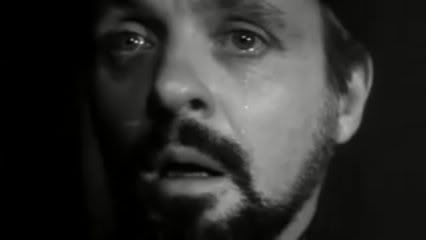
And what a body it is: whether seen in shadow or silhouette or even in the harsh light of day, it never fails to make an impression, even on one who has seen the film many times over. The first time Dr. Treves catches sight of Merrick -- having doggedly tracked him down after previously being denied access to him thanks to the inopportune intervention of the police -- he is actually brought to tears. And when Treves presents him to the London Pathological Society there are audible gasps and a great deal of consternation from the medical professionals present. But that's nothing compared to how women react to his grotesque countenance. Treves's wife manages to put on a brave face when he comes around to tea one afternoon, but eventually she breaks down sobbing, overcome by his plight. I suspect that has as much to do with how articulate and well-spoken he is as it does with his inescapably hideous appearance.<br />
 <br />
Much of the credit for making Merrick such an indelible character has to go to John Hurt, who does a yeoman's job of working under pounds of prosthetics and cumbersome makeup. "Can you imagine the kind of life he must have had?" asks hospital governor John Gielgud after he has learned that Merrick is not the imbecile everyone imagined him to be. He could have just as easily been talking about Hurt, who endured countless hours of pain and hardship to play the role. And it is a heartbreaking performance, whether he's desperately reciting the 23rd Psalm from memory or reading <I>Romeo and Juliet</I> out loud to a famous actress (Anne Bancroft) who has called on him or delivering the film's most famous line -- "I am not an animal! I am a human being!" -- to a bewildered crowd that has him cornered in a train station. No matter how many times it has been spoofed in the three decades since this film's release, it still grabs the viewer on a gut level. That's acting, folks.<br />
 <br />
In retrospect, <I>The Elephant Man</I>'s industrialized England doesn't look or sound too far removed from the hellish, post-industrial (post-apocalyptic?) landscape of <I>Eraserhead</I>, a film I didn't catch up with until several years later. This was, of course, at the tail end of the VHS era when copies were apparently quite scarce and the only video store I could find that carried it -- TLA Video in Philadelphia -- required a $120 deposit before one was allowed to rent it. Now that <I>Eraserhead</I> -- like all of Lynch's work, including his early shorts -- is readily available on DVD and even gets shown on cable once in a while, it's arguable that it's lost some of its cachet (maybe if it could still be seen in a darkened theater at midnight, it would get some of it back), but no matter how one views <I>The Elephant Man</I>, it continues to have an undeniable power that hasn't diminished over time. If the studios were still in the habit of re-releasing their classics in theaters, this would be a prime candidate, especially as this year is its 30th anniversary. They could even put it out on a double bill with <I>Raging Bull</I>; I guarantee there would be lines around the block.</p>

<p><B>Next up:</B> A comic tale of international espionage with a theme song by a former Beatle.</p>]]>
    </content>
</entry>

<entry>
    <title>Announcements, Announcements</title>
    <link rel="alternate" type="text/html" href="http://www.unloosen.com/thestuff/archives/2010/02/announcements_announcements.html" />
    <id>tag:www.unloosen.com,2010:/thestuff//2.619</id>

    <published>2010-02-09T19:05:10Z</published>
    <updated>2010-02-09T19:20:06Z</updated>

    <summary> So it&apos;s been a freakishly-busy six months for me. Aside from my normal work and my personal artwork, I&apos;ve also been creating artwork for a fairly large game project called Glitch. Today, Glitch was officially announced. More info: Official...</summary>
    <author>
        <name>Chris Leavens</name>
        <uri>http://www.unloosen.com/control/mt-cp.cgi?__mode=view&amp;blog_id=2&amp;id=1</uri>
    </author>
    
        <category term="Chris Leavens" scheme="http://www.sixapart.com/ns/types#category" />
    
        <category term="News" scheme="http://www.sixapart.com/ns/types#category" />
    
    
    <content type="html" xml:lang="en" xml:base="http://www.unloosen.com/thestuff/">
        <![CDATA[<p><span class="mt-enclosure mt-enclosure-image" style="display: inline;"><a href="http://www.unloosen.com/thestuff/illustration/Picture_6_610x296.png"><img alt="Picture_6_610x296.png" src="http://www.unloosen.com/thestuff/assets_c/2010/02/Picture_6_610x296-thumb-500x242.png" width="500" height="242" class="mt-image-center" style="text-align: center; display: block; margin: 0 auto 20px;" /></a></span></p>

<p>So it's been a freakishly-busy six months for me. Aside from my normal work and my personal artwork, I've also been creating artwork for a fairly large game project called <strong>Glitch</strong>. Today, <strong>Glitch</strong> was officially announced. More info:</p>

<p><a href="http://www.glitch.com">Official <strong>Glitch</strong> website!</a></p>

<p>I also had an interview published recently on the vector art website Vectortuts. <a href="http://vector.tutsplus.com/articles/interviews/interview-with-chris-leavens/">Here it is.</a></p>

<p>Lastly, if you're interested in amazingly-crazy music/art festivals, my art will be shown at this weekend's Lucent L'amour Festival here in LA. <a href="http://lucentlamour.com">Details.</a></p>

<p>More to come very soon!</p>]]>
        
    </content>
</entry>

<entry>
    <title>Explorers, reviewed by Craig J. Clark and Joe Blevins</title>
    <link rel="alternate" type="text/html" href="http://www.unloosen.com/thestuff/archives/2010/01/explorers_reviewed_by_craig_j.html" />
    <id>tag:www.unloosen.com,2010:/thestuff//2.618</id>

    <published>2010-01-28T22:00:24Z</published>
    <updated>2010-01-28T22:15:01Z</updated>

    <summary> Joe Dante holds something of a rarefied place in film fandom since he&apos;s one of the dreamers who was able to break into the industry and put his own fantasies on the screen. He started out by writing reviews...</summary>
    <author>
        <name>Craig J. Clark and Joe Blevins</name>
        <uri>http://www.unloosen.com/control/mt-cp.cgi?__mode=view&amp;blog_id=2&amp;id=45</uri>
    </author>
    
        <category term="Movies" scheme="http://www.sixapart.com/ns/types#category" />
    
        <category term="Reviews" scheme="http://www.sixapart.com/ns/types#category" />
    
    <category term="craigandjoewatchmoviesyouveactuallyheardof" label="craig and joe watch movies you&apos;ve actually heard of" scheme="http://www.sixapart.com/ns/types#tag" />
    
    <content type="html" xml:lang="en" xml:base="http://www.unloosen.com/thestuff/">
        <![CDATA[<p><IMG SRC="http://i799.photobucket.com/albums/yy272/craigjoeproject/02explorer.jpg"><br />
Joe Dante holds something of a rarefied place in film fandom since he's one of the dreamers who was able to break into the industry and put his own fantasies on the screen. He started out by writing reviews of genre films for fan magazines (which were later reprinted in <I>Video Watchdog</I>) and eventually got a job cutting trailers for Roger Corman's New World Pictures, which led to directing gigs like <I>Hollywood Boulevard</I> and <I>Piranha</I>. It was after he went out on his own to make <I>The Howling</I> that he was tapped by Steven Spielberg to direct one of the better segments of <I>Twilight Zone: The Movie</I> (the gonzo reimagining of "It's a Good Life") as well as <I>Gremlins</I>, which was such a major hit that it allowed him to develop a more personal project. That turned out to be 1985's <I>Explorers</I>, a feature-length wish-fulfillment fantasy for sci-fi geeks everywhere.<br />
 <br />
Best known today for marking the screen debuts of Ethan Hawke and River Phoenix, <I>Explorers</I> is mostly seen through the eyes of Hawke's pop-culture obsessive (obviously patterned after Dante), who gravitates to science fiction epics like <I>War of the Worlds</I> and <I>This Island Earth</I>, much like I was drawn to this film and watched it repeatedly when I was an impressionable young lad. Phoenix is much more down-to-earth, the rational proponent of science fact who is able to translate an image from Hawke's recurring flying dreams (which feature some <I>Tron</I>-like landscapes) into an actual circuit capable of creating a force field that he can control with his 128K Apple computer (an obvious hand-me-down from his computer-scientist father). To complete the trio they enlist gearhead Jason Presson, the product of a broken home who helps build and christen their spacecraft, the Thunder Road, which quite appropriately has a television screen as its main window. This is because when our three young explorers finally make it into space, they find that television has most emphatically preceded them.</p>]]>
        <![CDATA[<p>Before they get there, though, there's much ado about their interactions with each other and with their peers, most notably a bully who doesn't like anybody with a larger vocabulary than he has. (One of the deleted scenes on the DVD actually shows what led up to their confrontation. In the theatrical cut we're simply thrust into the middle of it, making it seem like we've been ambushed by this dullard in much the same way that Hawke is.) The three boys also take their time learning how the alien technology that's been zapped into their brains works and lovingly building the craft that they hope will take them into space safely -- and maybe even get them back home again.<br />
 <br />
If <I>Explorers</I> has a major flaw it is that its two halves don't mesh as well as they could. For one thing, it takes an hour for Hawke, Phoenix and Presson to actually leave Earth, and when they do they don't get to explore much before they're zapped through space to the alien ship that has been the source of the mysterious broadcasts. (It seems the aliens have been sending their own messages into space hoping to find those -- like Hawke -- with receptive minds.) As they set out on their journey Hawke exclaims with wonder, "It feels like a dream, doesn't it? I mean, it's all so perfect." After the three of them have spent several minutes wandering around the seemingly abandoned spaceship, though, he glumly concedes, "I hate to say this, but this isn't the way I thought it would be at all." I'm sure many filmgoers in 1985 felt the same way, even if Rob Bottin's creatures (once they appear) are pretty nifty. You just wish they had been given something more to do than spout pop-culture catchphrases and make obvious points about the way human beings treat aliens (or misfits of any kind, really) on Earth.<br />
 <br />
The constant stream of in-jokes is part and parcel of what makes a Joe Dante film a Joe Dante film, though. No matter what the project, he loves to pack his films with TV and movie references and it's quite possible that this one incorporates the most. He even includes a couple sly nods to his own films among the headlines of a prop newspaper ("Homewood School Teacher Reported Missing" for <I>Twilight Zone: The Movie</I> and "Kingston Falls 'Riot' Still Unexplained" for <I>Gremlins</I>). He also gives plum roles to Mary Kay Place as Hawke's indulgent mother and James Cromwell as Phoenix's absent-minded father, but he saves the best for two members of his repertory company.<br />
 <br />
First there's Robert Picardo (who got his break playing Eddie Quist, the psychopathic killer in <I>The Howling</I>) as the strong-chinned hero of <I>Starkiller</I>, a cheesy space opera with hilariously awful special effects seen playing at a drive-in. It's the kind of film that one could easily imagine Roger Corman picking up for domestic distribution. (If you look carefully, the scant dialogue in <I>Starkiller</I> is clearly dubbed -- and not very well, either.) Then there's Dante stalwart Dick Miller as a helicopter pilot who encounters the boys during their maiden flight and appears to be a threat that could ground them both literally and figuratively. As it turns out, though, he's sympathetic to their cause and even has a room full of miniature soldiers, showing one way in which adolescent fantasies can carry over into adulthood.<br />
 <br />
Speaking of which, one of the few nods in the direction of maturity in the film is represented by Hawke's hopeless crush on local girl Amanda Peterson (your standard, seemingly unattainable, girl next door-type), which is echoed by Phoenix's budding romance with a female alien. That may raise a few red flags for some (especially coming from the vantage point of one who has seen more adult fare like <I>Galaxy of Terror</I>), but the film as a whole is so sweet and innocent that's there's no chance of it turning icky at all. (The less said about Hawke's manipulation of the male alien's antennae, though, the better.)<br />
<IMG SRC="http://i799.photobucket.com/albums/yy272/craigjoeproject/02explorers.jpg"><br />
I would have been nine years old when <i>Explorers</i> was released in the summer of 1985, making me just a few years younger than its three suburban protagonists - Ben, Wolfgang, and Darren - but well within the age range to accept them as my onscreen surrogates. Seeing the movie back then might have been one of those pivotal moviegoing experiences that profoundly affected me for years afterward. Perhaps, like Craig, I would have watched the film over and over again had I been aware of it back then.<br />
 <br />
But I didn't see <i>Explorers</i> back in 1985. In fact, until Craig proposed covering the film for this series of reviews, I hadn't seen a frame of it. I never caught a few minutes of it on TV, never saw trailers or TV spots for it, never so much as glanced at a poster or VHS sleeve. I was only vaguely aware of its existence until recently, and I don't think I could have told you that Joe Dante was the film's director. In short, I approached <i>Explorers</i> as a complete newcomer with no expectations or emotional/nostalgic baggage.<br />
 <br />
Now that I have finally seen <i>Explorers</i>, I am of two minds about it because the film plays like two very different movies operating under the same banner and undergoes a radical shift in tone in its final third. But before we get to that, let's talk about that first two-thirds, shall we? This was a world I knew well. Our hero, Ben, is a young science-fiction junkie who spends his days dealing with typical kid problems (playground bullies, his first crush, schoolwork and teachers) but by night immerses himself in the fantastic world of comic books and vintage sci-fi movies. Brother, I can relate. I've been there, man. Definitely been there. If nothing else, <i>Explorers</i> offers a pitch-perfect snapshot of Reagan-era nerd culture in those pre-Internet days when it wasn't so easy to connect with others who shared your particular fetishes and when the precious raw material of geekdom (books, movies, TV shows) was not so plentiful or readily accessible either. Back then, being a nerd involved a bit more detective work and persistence.<br />
 <br />
<i>Explorers</i> also astutely captures a vital aspect of kid life usually ignored by movies: the state of being "friends-in-law." (Admittedly, I had to borrow that term from <i>Seinfeld</i>, but it's a valuable contribution to the language and should be in the dictionary.) The main character, Ben, has two friends in this flick: tough kid Darren and budding computer whiz Wolfgang. These three boys comprise the team that will eventually build a homemade spaceship and venture into the cosmos, but the whole enterprise centers around Ben. Without him, there's no way that Wolfgang and Darren would ever even meet, let alone hang out together. If Ben's family moved away from this town, Wolfgang and Darren would certainly not continue to be friends. These kinds of uneasy alliances are common when you're a kid. I liked how <i>Explorers</i> captured the dynamics operating within this group and how our three heroes were seemingly always squabbling amongst themselves, each child with his own personal agenda regarding How Things Should Be.<br />
 <br />
The writer, director, and actors should all receive credit for making these three boys seem very lifelike and making their little suburban world feel very lived-in and not simply contrived for the sake of the cameras. The semi-chaotic household in which serious-minded computer prodigy Wolfgang grows up particularly struck a chord with me - not because it reminded me of my own household (which was much more like Ben's) but because it so closely resembled that of one of my childhood friends, the first kid on our block to have a modem attached to his computer, the first in fact to actually have a computer in his room. Speaking of Wolfgang's family, I was impressed with the way <i>Explorers</i> refused to fall into the usual kid-movie trap of turning all the adult characters into fools, villains, or both. There is an adult character (played by Dick Miller) who does stumble onto the boys' home-grown space cruiser, and I kept waiting for this man to become the kids' scheming, nefarious nemesis. But the movie, mercifully, does not go in this direction.<br />
 <br />
Alas, the movie <i>does</i> take a wild new direction in its final third, and this was the point at which the spell wore off for me. I suppose in retrospect that Joe Dante's early-in-the-proceedings tribute to Looney Toons director Chuck Jones should have set off alarm bells, but nevertheless I was completely unprepared for <i>Explorers</i>'s sudden, third-act shift into madcap outer space Komedy with a Kapital K (like <i>Martians Go Home</i> or <i>Mom and Dad Save the World</i>). Up until this point, the movie had played like a much-subdued, more-realistic <i>Goonies</i> crossed with <i>Close Encounters of the Third Kind</i>. The movie had taken its characters and plot seriously and was doing what some of the best science-fiction stories can do: create in the viewer a sense of wonder and enchantment at the seemingly limitless possibilities afforded us by the vast reaches of the galaxy. I especially enjoyed the film's dream sequences with Ben soaring over a <i>Tron</i>-like landscape, and I was intrigued by the subplot in which it was revealed that other characters were having similar dreams. I wondered: where was this all heading?<br />
 <br />
Where it was heading was a garish, over-the-top, relentlessly zany and ultimately anticlimactic sequence set aboard an alien spacecraft. There, the three Earth boys interact with two bona fide aliens whose perceptions of humankind are based entirely on television. As Craig pointed out, the design of these creatures is quite remarkable. But my problem was, they don't look like they belong in this film. With their bulgy, fat-bottomed bodies and googly Muppet eyes, they look like they'd be more at home in, say, <i>Pufnstuf</i> or even <i>Meet the Feebles</i> than in <i>Explorers</i>. (One creature in this sequence, a magnificently-created robotic spider, was more in keeping with the film's overall production design.) The movie's sense of slowly-building wonder is simply tossed aside for frantic sketch-comedy schtick. Admittedly, there are some laughs here. I chuckled aloud at one alien's complete misreading of the TV show <i>Lassie</i>, for instance. Overall, though, this entire sequence felt grossly out of place and, worse yet, a betrayal of the film's first two-thirds. The film's closing moments do what they can to restore the earlier <i>Close Encounters</i>-ish sense of wonderment, but I was no longer on board. Now that we know what's <i>really</i> out there, we have to wonder if this entire journey was even worth the effort.<br />
 <br />
<i>Explorers</i> is 66.6% of a fine 1980s science-fiction adventure, and director Dante's eye for detail is evident throughout the entire production. The film is to be commended for its believable performances, still-impressive effects work, and dozens of thoughtful little flourishes. I have not even mentioned the film's hilarious movie-within-a-movie, <i>Starkiller</i> with the invaluable Robert Picardo. There is so much to praise about that 66.6%. But oh, that 33.3...</p>]]>
    </content>
</entry>

<entry>
    <title>Killer Klowns from Outer Space, reviewed by Joe Blevins and Craig J. Clark</title>
    <link rel="alternate" type="text/html" href="http://www.unloosen.com/thestuff/archives/2010/01/killer_klowns_from_outer_space.html" />
    <id>tag:www.unloosen.com,2010:/thestuff//2.617</id>

    <published>2010-01-14T23:00:33Z</published>
    <updated>2010-02-19T23:33:19Z</updated>

    <summary> Lots of science-fiction and horror films have been built around seemingly ridiculous high-concept gimmicks, particularly when it comes to totally improbable and impractical monsters. We&apos;ve had killer elevators, killer laundry-folding machines, killer tomatoes, killer beds, killer penises, etc. What...</summary>
    <author>
        <name>Joe Blevins and Craig J. Clark</name>
        <uri>http://www.unloosen.com/control/mt-cp.cgi?__mode=view&amp;blog_id=2&amp;id=44</uri>
    </author>
    
        <category term="Movies" scheme="http://www.sixapart.com/ns/types#category" />
    
        <category term="Reviews" scheme="http://www.sixapart.com/ns/types#category" />
    
    <category term="craigandjoewatchmoviesyouveactuallyheardof" label="craig and joe watch movies you&apos;ve actually heard of" scheme="http://www.sixapart.com/ns/types#tag" />
    
    <content type="html" xml:lang="en" xml:base="http://www.unloosen.com/thestuff/">
        <![CDATA[<p><IMG SRC="http://i799.photobucket.com/albums/yy272/craigjoeproject/01killer.jpg"><br />
Lots of science-fiction and horror films have been built around seemingly ridiculous high-concept gimmicks, particularly when it comes to totally improbable and impractical monsters. We've had killer elevators, killer laundry-folding machines, killer tomatoes, killer beds, killer penises, etc. What makes <I>Killer Klowns from Outer Space</I> (1988) so special is that the movie fully makes good on the promise of its extravagant title. If you want a rollicking, highly enjoyable movie about murderous extraterrestrial harlequins, look no further.<br />
 <br />
The Chiodo Brothers -- director Steven and his siblings Charles and Edward -- have worked together and separately on a variety of film and television projects for the last 20 years or so, generally as creature designers, puppeteers, and art directors. (All three toiled on <I>Team America: World Police</I>.) <I>Killer Klowns</I> is the Brothers' one big chance to run amok in a feature-length film, and they do not waste this golden opportunity. The film feels like the kind of thing a group of brothers might come up with in giggly, late-night brainstorming sessions.<br />
 <br />
STEVEN: So our villains are evil alien clowns, right?<br />
 <br />
EDWARD: <I>(snorting)</I> Yeah, and maybe their spaceship looks like a big circus tent!<br />
 <br />
CHARLES: And their weapons are popcorn and balloon animals! <I>(sprays Mountain Dew out his nose)</I><br />
 <br />
If the movie can be reduced to a formula, it would be: <I>The Blob</I> times <I>Gremlins</I> minus the actual monsters from those movies minus budget plus clowns plus terrible sweaters plus Dean Wormer from <I>Animal House</I>. That's a lot to absorb, so let me break it down.</p>]]>
        <![CDATA[<p>The action takes place over the course of one eventful night in a small, generally peaceful town where the local college kids (many of whom wear the aforementioned sweaters) are constantly running afoul of a local policeman, Mooney (played by John Vernon as an even-less-tolerant variation on Dean Wormer). A mysterious meteor crash-lands just outside of town, and some of the suspiciously old-looking "young people" go to investigate. All of this is imported straight from <I>The Blob</I>, as is the old hillbilly who is the film's first casualty. Anyway, the meteor turns out to be that circus tent/spaceship I mentioned previously, and soon the killer klowns themselves are unleashed on the unsuspecting citizenry, causing vaguely <I>Gremlins</I>-esque mayhem and occasionally killing people as well, wrapping their corpses in cotton candy cocoons. Really. Cotton candy cocoons. The actors even have to say the words "cotton candy cocoons" occasionally. Try saying it aloud yourself.<br />
 <br />
I suppose I should mention the film's token romantic leads, Mike and Debbie, or the town's only other cop, Dave, who also happens to be Debbie's still-jealous ex-boyfriend. But all that really needs to be said about them is that they play their roles just right, which is to say a little stiff and bland and only somewhat in on the joke. They help the movie to maintain its tricky balance of self-aware campiness and actual horror-movie creepiness. John Vernon and Royal Dano (as the hillbilly) have the fun roles here, and no scenery remains unchewed in their presence.<br />
 <br />
But you don't watch a movie like <I>Killer Klowns from Outer Space</I> for acting, do you? You watch it, I hope, for the CAS (crazy ass shit) contained within it. Does this movie deliver on the CAS? Oh, brother, you better believe that it does. The clowns -- excuse me, <I>Klowns</I> -- are about 8' tall generally, and their faces look like very elaborately-designed though not highly expressive Halloween masks. They are unable to speak, which in retrospect is probably a blessing, and move with a very plodding, deliberate gait. Occasionally, they will stage parades and puppet shows.... <I>deadly</I> parades and puppet shows, that is. I only wish the Chiodo Brothers had managed to wrangle some of those tiny Shriner cars. Those little cars have always unnerved me, and I know this film could have exploited them for maximum nightmare potential. But even without those cars, this is a movie that keeps on giving and giving. You want to see a biker get decapitated? How about an animated shadow puppet that eats a group of old people waiting for a bus? Dean Wormer's corpse used as a ventriloquist dummy? You've got it, pal. And what of our nation's most-famous clown, Ronald McDonald? Is his image sullied? You'd better believe it, as a super-menacing Klown stands outside a burger joint, beckoning to an innocent little girl. This is a movie where the CAS flows like running water. Even the movie's goofs are charming. There is a joke in which two horny brothers use an ice cream truck to lure overweight women, and you can tell that the filmmakers were only able to find one heavyset woman and one slightly plump one. For some reason, this made the film more endearing to me. As the frosting on this cinematic cupcake, we even have a kick-ass theme song by the Dickies!<br />
 <br />
<I>Killer Klowns from Outer Space</I> was not the beginning of a horror franchise. In fact, there never really was a second Chiodo Brothers film. Maybe this PG-13 oddity was slightly too innocent for the hardcore gore hounds out there and way too disturbing for younger audiences, placing it in a deadly commercial no man's land. But for those in the know, it remains -- even 20+ years on -- a slightly-under-the-radar delight.<br />
<IMG SRC="http://i799.photobucket.com/albums/yy272/craigjoeproject/01klowns.jpg"><br />
Quick question: Are you the sort of person who found the clown nightmare sequences in <I>Pee-Wee's Big Adventure</I> to be a little too intense and terrifying? If so, and you have heretofore managed to avoid <I>Killer Klowns from Outer Space</I>, then my best advice to you would be to stay that course, for it is practically by definition the last thing a person with Bozophobia should ever be exposed to. As for the rest of us, even after 22 years <I>Killer Klowns</I> can be a thoroughly entertaining way to pass 88 minutes -- as long as your expectations are sufficiently realistic.<br />
 <br />
For starters, the menacing laughter that is heard over the credits tells you right off the bat that this has the potential to be an especially creepy film. Then, after the major characters are sketchily introduced (with our main couple discovered making out in a blow-up raft in the back of a pickup truck -- which looks about as romantic as it sounds), the titular Klowns make their entrance, leaving no doubt that the creep-out factor will come into play several times before the closing credits roll. Even if you're not afraid of clowns, chances are you wouldn't want to run into any of these merry-makers in a dark alley.<br />
 <br />
As Joe stated, most of their armaments are sinister variations on such carnival staples as cotton candy, popcorn, balloon animals, puppet shows, squirting flowers, helium balloons and so on. Frankly, I'm surprised they didn't do anything with taffy pulling or funnel cakes (both of which could have had enormous potential), but they did manage to put a lethal spin on that classic slapstick routine, the pie fight. ("What are you gonna do with those pies, boys?" asks one hapless security guard just before he's pummeled to death by the Klowns' edible missiles. If there's one scene from this film that's stuck with me more than any other over the years, it is this one.)<br />
 <br />
If only the Brothers Chiodo had put as much effort into the dialogue as they did into the Klowns' ingenious devices. For example, Royal Dano gets to utter such deathless lines as "I don't know, Pooh. [Pooh being his droopy-face basset hound] There's something kind of peculiar around here." and "What in tarnation's going on here?" Later, when our intrepid couple is sprayed with popcorn while escaping from the Klowns' circus tent/spaceship, the girl asks, "Popcorn? Why popcorn?" "Because they're clowns, that's why!" comes her boyfriend's response. Then there are the lines that are uttered merely for the sake of irony, like when John Vernon growls, "Make a dummy out of yourself. You're not going to make a dummy out of me!" At least to the Chiodos' credit a good 30 minutes passes before Vernon does get turned into a dummy (in a scene that, now that I think of it, was eerily replayed in <I>Independence Day</I>). The same cannot be said for the biker who unwisely destroys the littlest Klown's motor scooter and, when the plucky fellow dons boxer's gloves, asks, "What are you gonna do, knock my block off?" That, sir, is exactly what he's going to do. Lastly, I was highly amused by Vernon's triumphant "Freak you's all!" -- a euphemism made necessary because he had already used up the film's quota of one "fuck" in the scene before.<br />
 <br />
Other areas where the film comes up short are the sub-John Carpenter synthesizer score (which is occasionally punctuated by some blistering guitar work) and the director's over-reliance on long takes of the ungainly Klowns casually strolling through the town. As much as it reeks of padding, it also reminds me of the sweaty stuntmen inside the top-heavy (because of the animatronic heads) Klown suits trying to get around with what must have been severely limited visibility. Then there are the comedic stylings of Michael Siegel and Peter Licassi as the Terenzi Brothers, who really should have been a lot funnier than they were if they were supposed to be the comic relief. On the plus side, the special effects are fairly decent for the money they had, but I couldn't help thinking of the Master Control Program from <I>Tron</I> when the big top took off into the stratosphere.<br />
 <br />
In a lot of ways the Killer Klowns' plot echoes the one in Peter Jackson's underseen feature debut, the aptly named <I>Bad Taste</I>, which came out the year before and likewise features a race of grotesque aliens who arrive on Earth with the intention of harvesting humans for their own sustenance. (In <I>Bad Taste</I>, though, their leader is much more articulate about their nefarious intentions -- namely, we are to be the latest intergalactic fast food delicacy.) The surprising thing is that <I>Killer Klowns</I> is the much slicker one of the two and clearly was the work of people who had something of a budget. <I>Bad Taste</I>, on the other hand, looks like Jackson made it single-handed, which isn't far off the mark considering he shot it on weekends over a period of several years and wound up playing multiple roles simply because he was the one actor he knew who would show up on a consistent basis. Now, I'm not saying the Chiodo Brothers aren't dedicated to their craft, but there's a reason why Jackson went on to helm some of the most ambitious films of the last two decades and win multiple Academy Awards in the process. It's all about ambition and when you get right down to it, once the Chiodos got to make their dumb movie about interstellar clown-like beings with advanced circus-based weapons technology, they must have felt like there was nowhere for them to go but down.<br />
 <br />
Then again, Wikipedia does say that they are developing a <I>Killer Klowns</I> sequel, so I guess we'll just have to wait and see what they come up with. Perhaps we have yet to hear the final word on murderous mummers from another galaxy. After all, the flying pies that splatter our protagonists in the final shot of this opus had to have come from somewhere.</p>]]>
    </content>
</entry>

<entry>
    <title>Craig and Joe Watch Movies You&apos;ve Actually Heard Of: An Introduction</title>
    <link rel="alternate" type="text/html" href="http://www.unloosen.com/thestuff/archives/2010/01/craig_and_joe_watch_movies_you.html" />
    <id>tag:www.unloosen.com,2010:/thestuff//2.616</id>

    <published>2010-01-11T23:33:12Z</published>
    <updated>2010-01-14T23:05:50Z</updated>

    <summary>Greetings, Unloosen reader(s), and welcome to what promises to be a bright, shining and -- for lack of a better term -- new decade. According to Arthur C. Clarke, 2010 is the Year We Make Contact, which raises the hope...</summary>
    <author>
        <name>Craig J. Clark</name>
        <uri>http://www.unloosen.com/control/mt-cp.cgi?__mode=view&amp;blog_id=2&amp;id=18</uri>
    </author>
    
        <category term="Movies" scheme="http://www.sixapart.com/ns/types#category" />
    
        <category term="Reviews" scheme="http://www.sixapart.com/ns/types#category" />
    
    <category term="craigandjoewatchmoviesyouveactuallyheardof" label="craig and joe watch movies you&apos;ve actually heard of" scheme="http://www.sixapart.com/ns/types#tag" />
    
    <content type="html" xml:lang="en" xml:base="http://www.unloosen.com/thestuff/">
        <![CDATA[<p>Greetings, Unloosen reader(s), and welcome to what promises to be a bright, shining and -- for lack of a better term -- new decade. According to Arthur C. Clarke, 2010 is the Year We Make Contact, which raises the hope that this will be the year that Unloosen reaches a wider readership. To that end, Joe Blevins and I have chosen to set aside the more esoteric fare that we're known for (so to speak) and start reviewing movies people have actually seen. And so we have settled on the storied decade known as the '80s, one which is beloved by countless VH1 commentators and is known for any of a number of high-profile motion pictures. Just don't think we're doing this out of some misplaced sense of nostalgia. Sure, most of the films that we plan on writing about on a biweekly basis (starting this Thursday) are ones that one or both of us saw -- in some cases, multiple times -- during our misspent youths, but we intend to look at them afresh with critical eyes. Will <em>Johnny Dangerously</em> be as funny as I thought it was before I reached puberty? Do the special effects in <em>Weird Science</em> hold up after two and a half decades? And does one really need to sit through <em>Ghandi</em> more than once in a lifetime? Stay tuned to find out.</p>]]>
        
    </content>
</entry>

<entry>
    <title>Fear Itself: &quot;The Circle&quot; -- reviewed by Joe Blevins and Craig J. Clark</title>
    <link rel="alternate" type="text/html" href="http://www.unloosen.com/thestuff/archives/2009/12/fear_itself_the_circle_--_revi.html" />
    <id>tag:www.unloosen.com,2009:/thestuff//2.615</id>

    <published>2009-12-17T23:33:07Z</published>
    <updated>2009-12-21T22:58:45Z</updated>

    <summary>EDITOR&apos;S NOTE: To bring &quot;Project: Fear Itself&quot; to a fitting conclusion, Craig J. Clark ventured to the Northwest suburbs of Chicago in order to view the final episode, &quot;The Circle,&quot; with Joe Blevins in person. What follows is a transcript...</summary>
    <author>
        <name>Joe Blevins and Craig J. Clark</name>
        <uri>http://www.unloosen.com/control/mt-cp.cgi?__mode=view&amp;blog_id=2&amp;id=44</uri>
    </author>
    
        <category term="Reviews" scheme="http://www.sixapart.com/ns/types#category" />
    
        <category term="Television" scheme="http://www.sixapart.com/ns/types#category" />
    
    
    <content type="html" xml:lang="en" xml:base="http://www.unloosen.com/thestuff/">
        <![CDATA[<p><I>EDITOR'S NOTE: To bring "Project: </I>Fear Itself<I>" to a fitting conclusion, Craig J. Clark ventured to the Northwest suburbs of Chicago in order to view the final episode, "The Circle," with Joe Blevins in person. What follows is a transcript of their post-show conversation.</I><br />
 <br />
<B>Craig:</B> So...<br />
 <br />
<B>Joe:</B> Sew buttons.<br />
 <br />
<B>Craig:</B> Yeah. And to think I drove all the way up here from southern Indiana for <I>that</I>.<br />
 <br />
<B>Joe:</B> Hey, it's better than what Johnathon Screech or whatever came up with for the screenplay to "The Circle." Wait, is it a screenplay? Isn't teleplay the word?<br />
 <br />
<B>Craig:</B> It is, and I actually <I>was</I> talking about the teleplay. And the guy's last name is Schaech, by the way, and he's not the only one responsible for this mess of an episode. His writing partner Richard Chizman (although Cheeseman might be more appropriate) is equally to blame.<br />
 <br />
<B>Joe:</B> I guess I was thinking of "Screech" because "The Circle" was roughly as scary as an episode of, let's say, <I>Saved By the Bell: The College Years</I>. Actually, not quite as scary. The people in this episode only had to deal with glum trick-or-treaters and this big wall of ink outside their remote cabin. They didn't have to face Dustin Diamond or Mario Lopez. That would have been more terrifying.</p>]]>
        <![CDATA[<p><B>Craig:</B> Wait, was Mario Lopez actually on <I>The College Years</I>? I thought he went off and made a TV movie about Greg Louganis or somebody. Some Olympic diver.<br />
 <br />
<B>Joe:</B> He did, but then it was right back to playing Zack Slater.<br />
 <br />
<B>Craig:</B> No, no. He played A.C. Slater. Zack Morris was played by that other guy, you know, the one who starred in <I>Dead Man on Campus</I> a.k.a. <I>Dead Film Career Walking</I>.<br />
 <br />
<B>Joe:</B> But he came back to haunt us on <I>NYPD Blue</I>. And speaking of people coming back in weirdly mutated form to menace us, this episode "The Circle" is full of that kind of crap.<br />
 <br />
<B>Craig:</B> Oh, dear. You really want to talk about the episode? I figured we could just run out the clock trading half-remembered <I>Saved by the Bell</I> trivia. I mean, we didn't even mention the chick who paraded around in her birthday suit in <I>Showgirls</I>. Hey, didn't one of the actresses in this episode kinda look like her?<br />
 <br />
<B>Joe:</B> It's hard to tell, because from what I remember, the actresses in this episode spend most of their time crawling around on the floor vomiting up something that looks like Quaker State.<br />
 <br />
<B>Craig:</B> I meant one of witches from the beginning. Remember, the part that looked like outtakes from the trick-or-treating sequence that opened "The Spirit Box"?<br />
 <br />
<B>Joe:</B> Wow... "The Spirit Box." Remind me, was that an episode of <I>One Day at a Time</I>? I kid, of course. I vaguely remember that scene. But <I>Fear Itself</I> episodes tend not to stay with me very long. I mean, I watched "The Circle" less than an hour ago, and I'm already having difficulty remembering the slightest detail about it.<br />
 <br />
<B>Craig:</B> That's understandable. Still, before this one completely evaporates from your memory, what did you think of the experience of watching an episode called "The Circle" on a little plastic circle called a DVD? Spooky, huh?<br />
 <br />
<B>Joe:</B> I don't really know. The circle motif felt a little forced. Like there's this evil book that's a main prop, and it has this big circle on the cover, right? And all I could think of was that Oprah magazine.<br />
 <br />
<B>Craig:</B> Oh?<br />
 <br />
<B>Joe:</B> That's the one. Wasn't Oprah the one who got people into that book, <I>The Secret</I>? I've never read that book, but the evil book in this movie kind of looked like it, what with that old-timey penmanship and all. Obviously, if you're watching a horror episode, and you're thinking about Oprah and <I>The Secret</I>, then someone's not doing his job. We watched the featurette about the making of the show and the director seemed on-point, so I'm laying the blame for this one at the feet of the writer slash star, Johnny Whatshisface, the Peter Gallagher-looking guy in the brown zip-up turtleneck thing from the LL Bean catalog. Remember that guy?<br />
 <br />
<B>Craig:</B> How could I forget that guy? I was the one who called him on his Peter Gallagher-ness. Still, even if he was the driving force behind the episode, I'll bet he didn't have final approval of props or anything. He was probably too busy sitting in his trailer dreaming up future Schaech/Chizman projects.<br />
 <br />
<B>Joe:</B> Well, his name was in the credits a bunch of times. I do know that. The more times your name appears in the credits, the more blame you take for the final product. That seems fair. This was essentially a Johnathon Schaech vehicle. I mean, it was practically "all Schaech Treatment, all the time." I think he even played one of those little girls at the beginning of the show, and I believe he knitted that turtleneck himself.<br />
 <br />
<B>Craig:</B> Would that make him a triple-threat? Writer/actor/knitter?<br />
 <br />
<B>Joe:</B> I didn't find him terribly threatening, no matter how much of a multi-hyphenate he is. That's the trouble here. This was another <I>Fear Itself</I> episode that wasn't even remotely scary. I think the pivotal moment was when Schaech-N-Baech wrestled around with a possessed woman in a dimly lit hallway. Now that sounds fairly exciting, right? But this was shot <I>Fear Itself</I>-style, meaning blurry and incomprehensible. You couldn't even tell what was going on. It might have been two actuaries squabbling over who gets the last cruller. But the show was educational. I mean, I learned that you can't keep an unstoppable evil force out of your house with towels. Doesn't work.<br />
 <br />
<B>Craig:</B> Not even when that unstoppable evil force is merely the manifestation of the monster from a horror author's bestselling novel? Speaking of which, I lost count of all the allusions to Stephen King. First of all, the guy's based out of Maine. Second, the episode's about a writer with writer's block, and it seems like every other Stephen King  character is a writer, frequently with writer's block. And then there were the obvious references to "The Word Processor of the Gods," <I>The Dark Half</I> and <I>The Shining</I>, although this episode's variation on "All work and no play makes Jack a dull boy" was a bit more of a mouthful. I also noted references to <I>Evil Dead 2</I> and John Carpenter's <I>Prince of Darkness</I>, even <I>Groundhog Day</I> and <I>The Neverending Story</I>. And then, of course, there's <I>The Ring</I>, which wasn't explicitly referenced, but the comparison is unavoidable.<br />
 <br />
<B>Joe:</B> If I were going to compare "The Circle" to anything, I'd probably say it's most like... well, like every other episode of <I>Fear Itself</I>, really. It's trying to be all shadowy and menacing and dark and disturbing, but the people in it all look like they could be hawking home electronics on QVC. Let me give you a for instance. There's this hot blondie witchiepoo who shows up maybe two-thirds of the way through. And she's stalking around the room, trying to be sexy and dangerous and the whole schmear. Her invasion of the story should be a game changer, but somehow all she manages to do is make "The Circle" even more boring. It's kind of appropriate that this episode was about a group of people trapped in a circle of black nothingness, because that's how the <I>Fear Itself</I> viewer is likely to feel each and every week.<br />
 <br />
<B>Craig:</B> Well, no more, Joe. After all, this is the last episode of <I>Fear Itself</I> -- and it never even aired on American television. Do you think NBC's programming executives were attempting to shield us from something... ominous? I mean, the rule of thumb is you try to save the best for last and this was in no way, shape or form the best episode <I>Fear Itself</I> had to offer. Even on the page it must have seemed like a bore, and that was before the tepid dialogue was put into the mouths of some of the most awful overacters Canada could produce. Especially the brunette who played Kate, the wife of Master Schaech's editor. She had one of the worst freak-outs I've ever seen outside of a <I>Scared Straight</I>-style anti-drug screed.<br />
 <br />
<B>Joe:</B> The brunette was maybe my favorite thing about the episode, to be honest. Right off the bat, her line readings were very noticeably off -- too stiff and loud. But then weird supernatural stuff starts going down, and she goes into insane bad actress overdrive and really starts earning that big fat NBC paycheck. I never want to see her in anything again, but I was glad she was in this. Thank you, crazy loud brunette lady, for providing the few moments of amusement in this 43 minutes of blah. In a way, "The Circle" was a very appropriate finale for <I>Fear Itself</I>. As you noted, it's not nearly the show's best, but it isn't the worst either. And it features many of the time-honored and beloved <I>Fear Itself</I> tropes: doorknobs turning slowly, creepy kids, exposition-heavy dialogue, people in dark rooms calling out to each other, and -- oh, yeah -- a twist ending. Where would a <I>Fear Itself</I> episode be without a feeble twist ending?<br />
 <br />
<B>Craig:</B> Still on the air?<br />
 <br />
<B>Joe:</B> Possibly. But I wanted to ask you a plot question, which would require me to spoil the holy living bejeezus out of this episode--<br />
 <br />
<B>Craig:</B> Oh, go right ahead, Joe. It's not anyone ever has -- or ever will -- actually see "The Circle," outside of you and me.<br />
 <br />
<B>Joe:</B> Okay, well, the characters, it turns out, are stuck in this constantly repeating Moebius strip of time, doomed to play out the same scenario over and over forever. Okay, I'm cool with that. These people are tools and probably wouldn't be doing anything interesting with their lives anyway. Go ahead, God, put 'em in a badly written horror story for all eternity. Fine. But -- and here's my objection -- there are these two little girls who appear to present Schaech Yerbouti with his evil Oprah book, you dig? Okay, their part of the story only lasts a minute or so. But if the story is going to repeat itself endlessly, that means these two kids are going to have to keep showing up to do their part over and over. And they're just minor supporting players! What a waste! These little kids might have gone on to cure cancer or something, but no. Some horror writer dabbles in extracurricular nookie with a witch, and that means these girls are stuck playing their underwritten roles until the end of time. What are they doing for the rest of the loop when they're offstage, so to speak? I imagine that they're in some kind of Green Room of the Damned, smoking, drinking, waiting for their cue. "Oh, crap, it's time to give that guy his stupid devil book again." What's your take on this, Craig?<br />
 <br />
<B>Craig:</B> Joe, I think you've just put more thought into this episode than anyone who was actually involved in its making. Congratulations.<br />
 <br />
<B>Joe:</B> Typical! Schaech the Monkey is a terrible God to his characters, even the one who's played by him.<br />
 <br />
<B>Craig:</B> And if I were him, I would have fired the makeup person -- or at least kept them away from the mascara. By the end it looked like he was trying out for a Bangles video or something.<br />
 <br />
<B>Joe:</B> Couldn't have said it better myself. So... are we done? Have we discussed "The Circle" to its fullest extent?<br />
 <br />
<B>Craig:</B> I don't know. Did we mention that it was actually based on a short story? I believe that's a first for <I>Fear Itself</I>, unless... Wasn't "The Sacrifice" based on a short story? Have we truly gone full circle? Is there a mildly retarded man-child named Lemmon lurking behind the next corner waiting to pounce on us as soon as we leave here?<br />
 <br />
<B>Joe:</B> Yes. With "The Circle," <I>Fear Itself</I> has somehow lapped itself. Will the circle be unbroken? By and by, Lord. By and by. There's a better horror anthology series awaiting. In the sky, Lord. In the sky. But, getting back to your point, being a <I>Fear Itself</I> episode based on a short story is like being a quadruple amputee with a nice hat. It may be a swell hat, but it doesn't do you much good when your nose itches.<br />
 <br />
<B>Craig:</B> I'm reminded of Roger Ebert's analogy about the trick of the dog standing on its hind legs. The wonder is not so much that it's being done well, but that it's being done at all. I'd say that's pretty apt since most of the episodes of <I>Fear Itself</I> belong in a kennel. The kind of kennel where the family dog gets dropped off at the beginning of summer vacation and then never gets picked up again.<br />
 <br />
<B>Joe:</B> Sad but true. I'd just like to wrap up by saying that the moral of this episode was that, if you're a writer, you should write pornography instead of horror. Because, after all, if you're going to write yourself into an inescapable loop, you might as well enjoy yourself. Was there an overall moral to <I>Fear Itself</I> besides "Don't watch <I>Fear Itself</I>?" Or is there something you'd like to say to <I>Fear Itself</I> creator Mick Garris?<br />
 <br />
<B>Craig:</B> Probably just that if he should return to the television anthology well for a fourth time, he should seriously consider adapting more short stories instead of letting his writers come up with their own, highly derivative yarns. Not that "The Sacrifice" and "The Circle" were any great shakes, but they were leagues ahead of barrel scrapings like "Community" and "In Sickness and in Health" -- and those are two of the episodes that <I>aired</I>. Oh, yes. And one other thing: stay away from networks that could possibly contract Olympic fever and forget all about your show while in a flu-ridden delirium. So, until next time, Joe...<br />
 <br />
<B>Joe:</B> Unless "The Circle" turns out to be one of those <i>Ringu</i> deals where we both die seven days after watching it.<br />
 <br />
<B>Craig:</B> Well, if that's the case, it's been an honor and privilege working with you and I guess I'll see you in Hell. Let's just hope they don't have <I>Fear Itself</I> on an endless loop there.</p>]]>
    </content>
</entry>

<entry>
    <title>We&apos;re Up Here</title>
    <link rel="alternate" type="text/html" href="http://www.unloosen.com/thestuff/archives/2009/12/were_up_here.html" />
    <id>tag:www.unloosen.com,2009:/thestuff//2.614</id>

    <published>2009-12-12T18:27:09Z</published>
    <updated>2009-12-12T18:28:41Z</updated>

    <summary> My latest piece, created for the first edition of Colorvision Magazine! Vector Art, Adobe Illustrator CS4...</summary>
    <author>
        <name>Chris Leavens</name>
        <uri>http://www.unloosen.com/control/mt-cp.cgi?__mode=view&amp;blog_id=2&amp;id=1</uri>
    </author>
    
        <category term="Chris Leavens" scheme="http://www.sixapart.com/ns/types#category" />
    
        <category term="Images" scheme="http://www.sixapart.com/ns/types#category" />
    
    
    <content type="html" xml:lang="en" xml:base="http://www.unloosen.com/thestuff/">
        <![CDATA[<p><span class="mt-enclosure mt-enclosure-image" style="display: inline;"><a href="http://www.unloosen.com/thestuff/assets_c/2009/12/cVision2.html" onclick="window.open('http://www.unloosen.com/thestuff/assets_c/2009/12/cVision2.html','popup','width=693,height=594,scrollbars=no,resizable=no,toolbar=no,directories=no,location=no,menubar=no,status=no,left=0,top=0'); return false"><img src="http://www.unloosen.com/thestuff/assets_c/2009/12/cVision2-thumb-500x428.jpg" width="500" height="428" alt="cVision2.jpg" class="mt-image-center" style="text-align: center; display: block; margin: 0 auto 20px;" /></a></span></p>

<p>My latest piece, created for the first edition of <a href="http://colorvisionmag.com/" rel="nofollow">Colorvision Magazine</a>!</p>

<p>Vector Art, Adobe Illustrator CS4</p>]]>
        
    </content>
</entry>

<entry>
    <title>Fear Itself: &quot;Echoes&quot; -- reviewed by Craig J. Clark and Joe Blevins</title>
    <link rel="alternate" type="text/html" href="http://www.unloosen.com/thestuff/archives/2009/12/fear_itself_echoes_--_reviewed.html" />
    <id>tag:www.unloosen.com,2009:/thestuff//2.613</id>

    <published>2009-12-11T01:15:41Z</published>
    <updated>2009-12-19T16:11:00Z</updated>

    <summary><![CDATA["Pinch hitting for Pedro Borbon... Manny Mota... Mota... Mota..." - ROBERT HAYS "You ever have really strong d&eacute;j&agrave; vu?" - AARON STANFORD If you'll permit the indulgence, before I get to "Echoes" -- the penultimate episode of Fear Itself --...]]></summary>
    <author>
        <name>Craig J. Clark and Joe Blevins</name>
        <uri>http://www.unloosen.com/control/mt-cp.cgi?__mode=view&amp;blog_id=2&amp;id=45</uri>
    </author>
    
        <category term="Reviews" scheme="http://www.sixapart.com/ns/types#category" />
    
        <category term="Television" scheme="http://www.sixapart.com/ns/types#category" />
    
    
    <content type="html" xml:lang="en" xml:base="http://www.unloosen.com/thestuff/">
        <![CDATA[<p><I>"Pinch hitting for Pedro Borbon... Manny Mota... Mota... Mota..."</I> - ROBERT HAYS</p>

<p><I>"You ever have really strong d&eacute;j&agrave; vu?"</I> - AARON STANFORD</p>

<p>If you'll permit the indulgence, before I get to "Echoes" -- the penultimate episode of <I>Fear Itself</I> -- I feel there's something I have to get off my chest. I'm beginning to worry about Joe. I hate to say it, but I think this project may have finally broken him.</p>

<p>Remember last summer, when his <I>Fear Itself</I> reviews contained wild flights of fancy about kinky senior citizens and improbable trips to Morocco and so forth? Well, look at them now. For the past few weeks my colleague has done little more than morosely catalog each ensuing episode's shortcomings (of which, it must be said, there have been many) and throw in an off-hand reference to the Coen Brothers or Bugs Bunny and call it a day. What happened to the bright young Mr. Blevins who would use the tools of satire to extol the virtues of nepotism in the entertainment industry or write an entire installment as if he were Marty McFly addressing the president of NBC? Sadly, I fear the will to sustain such an elaborate construct has been beaten out of him by the paucity of creativity on display in the show itself, which begs the question: Is this what we were supposed to fear? Not fear itself (or even <I>Fear Itself</I>), but rather the dulling of the imagination? Maybe so, maybe so...</p>]]>
        <![CDATA[<p>Well, let's get to "Echoes," shall we? If you haven't seen the episode in question (and chances are very great that you haven't), I might be able to save you the trouble by asking this one simple question: Have you ever seen Kenneth Branagh's <I>Dead Again</I>? If you have, then you have essentially seen "Echoes," a story about d&eacute;j&agrave; vu and reincarnation that is for all intents and purposes a pale imitation of a story about d&eacute;j&agrave; vu and reincarnation. And they say there's nothing new under the sun.</p>

<p>Directed by Rupert Wainwright, who can also be held responsible for the remake of <I>The Fog</I> as well as <I>Stigmata</I> and <I>Please Hammer, Don't Hurt 'Em: The Movie</I>, "Echoes" opens with grad student Aaron Stanford moving into a ginormous house so he can work on his dissertation (on what subject we never find out) and almost immediately being assaulted by visions of one of its former residents, a short-tempered brute named Maxwell (Eric Balfour, whose credits include the atrocious <I>Texas Chainsaw Massacre</I> remake) who apparently killed his flapper girlfriend Zelda (Camille Guaty) on the premises. By sheer coincidence, Guaty also plays Stanford's would-be, possibly, maybe-if-he-had-the-balls-to-ask-her-out girlfriend in the present, which either makes her Zelda's reincarnation or the production just decided to cut corners on casting.</p>

<p>The other major character is Stanford's therapist (Gerard Plunkett), who is practically pushing him to jump Guaty's bones and, once he learns of Stanford's visions, begins putting him under hypnosis and recording their sessions on CD, presumably so he can play them at parties. ("Hey, everybody! Get a load of my new client. When I put him under he starts drawlin' like he's from Nawlins!") Speaking of parties, this episode features a couple of doozies. The first one, which takes place in the past, features Balfour being driven into a homicidal rage by the sight of girls kissing girls and guys kissing guys (oh, the scandal!) and eventually giving some older guy who was talking to Zelda the <I>American History X</I> doorstep teeth-stomp treatment. The entire scene is then repeated almost verbatim with Guaty throwing a surprise housewarming bash for Stanford, who similarly becomes enraged by the sight of same-sex couples snogging away and takes violent action of his own.</p>

<p>This isn't the only example of doubling in the script, but it is the most blatant. In fact, this entire episode must have extremely easy on writer Sean Hood (whose previous credits include various installments of the <I>Halloween</I>, <I>Cube</I> and <I>The Crow</I> franchises, plus an uncredited rewrite on <I>Cursed</I>, which, as one of the saddest werewolf movies in recent memory, hardly endears him to me) since all he had to do was write half of it and then copy and paste whole scenes and lines of dialogue and just change the character names. That's not an echo, though. That's practically a carbon copy, which raises the spectre of <I>Dead Again</I> once again, but never more so than when the climactic murder turns out to have been misrepresented all along. Of <I>course</I>. I never thought I'd say this, but I can't wait for "Project: <I>Fear Itself</I>" to be over so Joe and I can find something else to review. Maybe next time, though, we should pick something with a little ambition behind it.</p>

<p>Stray observations:</p>

<p>* Whenever a naked girl in a tub full of blood spontaneously appears in your spacious bathroom and whispers, "Help me, help me," that's the time to call up your leasing agent and get your deposit back.</p>

<p>* At one point we see Stanford and Guaty playing a Scrabble knockoff called Word Food. Now, I realize they're not going to be able to play a trademarked game like Scrabble, but Word Food? Who the fuck came up with that?</p>

<p>* This is one the much-heralded "Director's Cuts" featured on the DVD release, which presumably accounts for the fleeting shots of sideboob in the party scenes. Not sure whether those made it onto FEARnet. I guess that's a question for my compatriot. Oh, Joe?</p>

<p><CENTER>* * *</CENTER><br />
<I>(AUTHOR'S NOTE: There was no nudity that I could see in the FEARnet version of this episode, not that it would've helped much if there had been. I am sorry Mr. Clark finds my recent reviews to be insufficiently zany and will endeavor to make this one more self-consciously "wacky.")</I><br />
 <br />
God, what an insufferable decade the 1920's must've been!<br />
 <br />
Everyone was so smug and annoyingly carefree then, constantly dancing the Charleston and drinking illegally-manufactured alcohol at noisy parties which lasted days or even weeks. And instead of saying anything useful, people would just spout gibberish like "23 Skidoo!" and "flibbity bibbity!" Women wore those stupid feathery headbands at all times, and I believe every last one of them was named Zelda. If you had a problem, good luck getting someone to help you in the 1920's. It would probably go down like this:<br />
 <br />
YOU: Help! My house is burning down!<br />
 <br />
TYPICAL TWENTIES PERSON: Well, shave my fanny and call me Uncle Blizzblozz! If'n that ain't the monkey's toothbrush!<br />
 <br />
YOU: Please call the fire department! My child is in there!<br />
 <br />
TYPICAL TWENTIES PERSON: Keep your suspenders on, schmegegge! Don't let those horsefeathers give you the heebie jeebies! You're slingin' more coleslaw than a canary in Utica!<br />
 <br />
YOU: Oh God! OH GOD!!<br />
 <br />
<I>(You begin weeping bitterly. The TTP starts dancing the Charleston atop a Duesenberg, which in no way alleviates the situation.)</I><br />
 <br />
Thank God the Great Depression came along and wiped the smirks off their horrid, moonpie-shaped faces! They ought to put Herbert Hoover on Mt. Rushmore for that!<br />
 <br />
All of this brings me back to "Echoes," the <I>Fear Itself</I> episode which was not based on the Pink Floyd song of the same name. Instead, it tells the tale of a schlubby-looking, weak-chinned loser who rents a house and soon finds he is haunted by violent visions of events from the dreaded and dreadful 1920's, America's stupidest decade, nudging out even the 1970's. The "stars" of these visions are the former occupants of the house: two complete idiots named Maxie and (you guessed it) Zelda, though I know them as "Stabby" and "Strippy" respectively, since Maxie is always flicking his switchblade at people and Zelda divides her time between taking bubble baths and getting ready to take bubble baths. The actress playing Zelda also plays a parallel character in the modern day scenes and gets plenty of "tub time" here as well. I'm guessing this poor actress got some very wrinkly skin out of this job!<br />
 <br />
Like virtually all <I>Fear Itself</I> episodes, "Echoes" has the dark, grainy, underlit look of a public service announcement about the dangers of using crystal meth. The acting, too, is typical of the series: a lot of low-key, monotone mumbling punctuated by a few overheated "dramatic" moments in which the actors yell at each other and lurch wildly from one end of the set to the other, often breaking perfectly good props in the process. I do want to single out the schlubby guy for specific ridicule for the scenes in which he unconvincingly "channels" Maxie to a headshrinker. Homeboy sounds just like Harry Connick, Jr. eating a peanut butter sandwich.<br />
 <br />
If the prospect of Harry Connick, Jr. eating a peanut butter sandwich fills you with dread, then "Echoes" just might keep you up nights. Otherwise, feel free to screen this at your next meeting of Paranoid Schizophrenics Anonymous. No one will be even slightly bothered by it.</p>]]>
    </content>
</entry>

<entry>
    <title>Fear Itself: &quot;The Spirit Box&quot; -- reviewed by Joe Blevins and Craig J. Clark</title>
    <link rel="alternate" type="text/html" href="http://www.unloosen.com/thestuff/archives/2009/12/fear_itself_the_spirit_box_--.html" />
    <id>tag:www.unloosen.com,2009:/thestuff//2.612</id>

    <published>2009-12-03T23:57:04Z</published>
    <updated>2009-12-04T23:44:56Z</updated>

    <summary>While watching &quot;The Spirit Box,&quot; yet another previously-unaired episode of Fear Itself, I could not help but hearken back to the convoluted origins of one of America&apos;s favorite cartoon characters, Bugs Bunny. The mischievous rabbit was not the creation of...</summary>
    <author>
        <name>Joe Blevins and Craig J. Clark</name>
        <uri>http://www.unloosen.com/control/mt-cp.cgi?__mode=view&amp;blog_id=2&amp;id=44</uri>
    </author>
    
        <category term="Reviews" scheme="http://www.sixapart.com/ns/types#category" />
    
        <category term="Television" scheme="http://www.sixapart.com/ns/types#category" />
    
    
    <content type="html" xml:lang="en" xml:base="http://www.unloosen.com/thestuff/">
        <![CDATA[<p>While watching "The Spirit Box," yet another previously-unaired episode of <I>Fear Itself</I>, I could not help but hearken back to the convoluted origins of one of America's favorite cartoon characters, Bugs Bunny. The mischievous rabbit was not the creation of any one man, though several directors at Warner Brothers have taken credit for him over the years. Instead, everything we know about the character -- his name, his appearance, his personality, his trademark comedy bits -- took shape over a number of cartoons released between 1938 and 1940. Even Bugs's deathless catch phrase was a collaborative effort. Bob Clampett came up with the first draft -- "What's up, duke?" -- which Tex Avery would later refine to "doc." Years later, talking to a biographer, Avery would remark on the effect the phrase first had on audiences: "They expected the rabbit to scream or anything but make a casual remark. For here's a guy pointing a gun in his face! It got such a laugh that we said, 'Boy, we'll do that every chance we get.'"</p>]]>
        <![CDATA[<p>I retell that story because it offers a snapshot of how clich&eacute;s become clich&eacute;s. Quite simply, clich&eacute;s work. For whatever reason, they get a measurable reaction, so they reappear endlessly for years or even decades. An episode like "The Spirit Box" -- in which two bored teenage girls construct a Ouija-board-like device out of a pizza box and subsequently investigate the mysterious death of a classmate -- consists almost entirely of tropes borrowed from countless other horror and suspense movies. The setup feels contrived. The dialogue is heavy on exposition and never feels spontaneous or believable for even a moment. The acting seems rather lethargic, even though the cast includes up-and-comer Anna Kendrick (<I>Twilight</I>, <I>Up in the Air</I>) and veteran character actor Mark Pellegrino (beloved for his role as the dimwitted blond thug who has trouble identifying a bowling ball in <I>The Big Lebowski</I>). The direction, production design, and cinematography seem rote at best. And despite all this, I must admit that I was intermittently wrapped up in "The Spirit Box," mainly because of its use of stock situations which have worked well in other movies.<br />
 <br />
Let me give you an example. You know those scenes in which the hero sneaks into someone else's home, looking for some clue to a mystery, and then the owner unexpectedly shows up, and the hero's accomplice (waiting outside) knows it but the hero doesn't know it? Well, "The Spirit Box" has one of those scenes, and even though I couldn't honestly say I cared about any of the parties involved, I did sort want to know how it played out. Maybe it's because we all secretly wonder what we would do under similar circumstances. How would we get out of there? What's our strategy? Hide in the closet? Jump out the window? What now?<br />
 <br />
The problem with "The Spirit Box" is that the resolution to this scene (and many others) is fairly lame both in conception and execution. This story has nothing going for it except for those stock situations and horror movie tropes. It boasts no good original ideas and not a single memorable character or line of dialogue. Once you have watched it, unless you are composing a review for Unloosen, there is no need ever to reflect upon it again. In fact, it offers so little fodder for contemplation that I had to include a wildly irrelevant anecdote about Bugs Bunny in the first paragraph of this brief precis.<br />
 <br />
P.S. - The mark of a good twist ending is that you can watch the story a second time and all the elements of the plot will now make perfect sense. "The Spirit Box" does not have a good twist ending.</p>

<p><CENTER>* * *</CENTER><br />
Much as I am loath to admit it, Joe is absolutely correct when he writes that the twist ending of "The Spirit Box" is not a particularly good one. Of course, this has been <I>de rigueur</I> for the series from the get-go, so I don't know why he was expecting to see one magically materialize in week 11 of <I>Fear Itself</I>. In fact, this entire episode can be summed up by the line "God, this is beyond lame," which star Anna Kendrick utters within the first few minutes. The fact that she does so while dressed in a silly Halloween witch costume -- which, in light of her nascent interest in Wicca, is totally, like, ironic or something -- is simply the icing on the cake.<br />
 <br />
Directed by Rob Schmidt, whose 2003 horror outing <I>Wrong Turn</I> has gone unseen by me and will continue to go unseen by me, "The Spirit Box" is a ghost story for the Twitter age, a moderately facetious designation that contains a germ of truth since it appears to have been made for and by some grade-A twits. The story is about a stereotypical goth chick (like, she totally wears black nail polish and everything) Kendrick and her best friend, cheerleader Jessica Parker Kennedy, getting in touch with the spirit of a dead classmate who insists on using irritating abbreviations like "L8R" -- because when you're dead you obviously don't have the time for niceties like spelling out entire words. Kendrick also has to contend with being the daughter of overprotective cop Martin Donovan, who apparently has no problem with letting her do laps by herself at the school swimming pool at an obscenely early hour of the morning. After all, what better time is there for her to be menaced by a Commedia dell'Arte character in a parka? (Either that, or they're the Tatooinian informant from <I>Star Wars</I>, take your pick.)<br />
 <br />
Unsurprisingly, "The Spirit Box" has room for many such gaps in logic. For example, if you're going out to the place where a dead girl was found in order to get "more bars" when you try to contact her, wouldn't you want to tote your homemade Ouija board with you instead of having to go back to the car to get it? The scene where this occurs also features one of the most easily anticipated jump scares in the history of jump scares when Kendrick gets some mud on her hands and goes down to the water's edge to wash it off. As soon as she leaned over I literally counted the seconds until a disembodied hand reached out of the water to give her a jolt. What especially amused me was the way Schmidt uses a loud noise to provoke the scare not once but twice. The first time is when the hand springs out, causing Kendrick to jump. The second happens immediately after when we come back from commercial (a device, it must be said, that loses whatever impact it may have had when the episode is viewed on DVD or online). As Count Floyd would say, "Ooh, scary."<br />
 <br />
As for the scene Joe mentions above, I know for a fact that he really got caught up in the suspense of the moment since he sent me a bewildering pair of texts ("OMG HES GOT A LCTRIC KNIFE" and "DONT TASE HIM SIS") while it played out. And later on when the lame twist was about to be revealed, he sent me one that simply read "OMG IT WAS TTLY BECCA." Dude, next time don't forget the SPLR ALRT. KTHXBAI.</p>]]>
    </content>
</entry>

<entry>
    <title>Francine</title>
    <link rel="alternate" type="text/html" href="http://www.unloosen.com/thestuff/archives/2009/12/francine.html" />
    <id>tag:www.unloosen.com,2009:/thestuff//2.611</id>

    <published>2009-12-02T21:11:22Z</published>
    <updated>2009-12-02T21:29:18Z</updated>

    <summary><![CDATA[Here's my 2009 Christmas card design: The inside reads: &quot;The only gift Francine the reindeer wanted for Christmas was the one no one would give him: a new name.&quot; I'll have a few extras, so if you're interested in purchasing...]]></summary>
    <author>
        <name>Chris Leavens</name>
        <uri>http://www.unloosen.com/control/mt-cp.cgi?__mode=view&amp;blog_id=2&amp;id=1</uri>
    </author>
    
        <category term="Chris Leavens" scheme="http://www.sixapart.com/ns/types#category" />
    
        <category term="Images" scheme="http://www.sixapart.com/ns/types#category" />
    
    
    <content type="html" xml:lang="en" xml:base="http://www.unloosen.com/thestuff/">
        <![CDATA[<p>Here's my 2009 Christmas card design:</p>

<p><span class="mt-enclosure mt-enclosure-image" style="display: inline;"><a href="http://www.unloosen.com/thestuff/assets_c/2009/12/francine.html" onclick="window.open('http://www.unloosen.com/thestuff/assets_c/2009/12/francine.html','popup','width=500,height=700,scrollbars=no,resizable=no,toolbar=no,directories=no,location=no,menubar=no,status=no,left=0,top=0'); return false"><img src="http://www.unloosen.com/thestuff/assets_c/2009/12/francine-thumb-500x700.jpg" width="500" height="700" alt="francine.jpg" class="mt-image-center" style="text-align: center; display: block; margin: 0 auto 20px;" /></a></span></p>

<p>The inside reads:</p>

<p>&quot;The only gift Francine the reindeer wanted for Christmas was the one no one would give him: a new name.&quot;</p>

<p>I'll have a few extras, so if you're interested in purchasing a set, just post a comment!</p>]]>
        <![CDATA[<p>Here's the back:</p>

<p><span class="mt-enclosure mt-enclosure-image" style="display: inline;"><img alt="cardBack.jpg" src="http://www.unloosen.com/thestuff/illustration/cardBack.jpg" width="360" height="504" class="mt-image-center" style="text-align: center; display: block; margin: 0 auto 20px;" /></span></p>]]>
    </content>
</entry>

<entry>
    <title>Having Some Larfs with the Invisible Man Backstage</title>
    <link rel="alternate" type="text/html" href="http://www.unloosen.com/thestuff/archives/2009/11/having_some_larfs_with_the_inv.html" />
    <id>tag:www.unloosen.com,2009:/thestuff//2.610</id>

    <published>2009-11-26T17:00:35Z</published>
    <updated>2009-11-26T17:07:30Z</updated>

    <summary>Well, naturally, the act has evolved over the years. For business reasons, mainly. I mean, you&apos;ve gotta change with the times or the crowds... well, the crowds go elsewhere. And in a town like this, there&apos;s plenty of elsewhere for...</summary>
    <author>
        <name>Joe Blevins</name>
        <uri>http://www.unloosen.com/control/mt-cp.cgi?__mode=view&amp;blog_id=2&amp;id=22</uri>
    </author>
    
        <category term="Fiction" scheme="http://www.sixapart.com/ns/types#category" />
    
        <category term="Joe Blevins" scheme="http://www.sixapart.com/ns/types#category" />
    
    
    <content type="html" xml:lang="en" xml:base="http://www.unloosen.com/thestuff/">
        <![CDATA[<p>Well, naturally, the act has evolved over the years. For business reasons, mainly. I mean, you've gotta change with the times or the crowds... well, the crowds go elsewhere. And in a town like this, there's plenty of elsewhere for them to go, if you get my drift. So you've gotta keep adding new gimmicks to the act, new twists, new cast members. When I started, it was just me. That was enough for 'em in the beginning. Hell, half the act was Q&A with the audience. Now we've got, what, forty people in the cast -- dancers, backup singers, et cetera. Not to mention the pyrotechnics, the lighting. It's quite a production now. A circus. And, of course, all of this costs money. I should know that better than anyone, since it comes outta MY bottom line. But my manager, Gary, keeps giving me the old "spend money to make money" routine.<br />
 <br />
Where is that bastard, anyway? He's never around when I need him. I'm the Invisible Man, and he's the Invisible Manager. Heh. Probably off snorting more of my money up that big schnoz of his. Don't print that.</p>]]>
        <![CDATA[<p>Listen, while you're up, pour me a drink, will ya? Scotch and soda. Thanks. Woah, easy! Easy! I gotta show to do in 20 minutes. There you go. You can take your hand away. I got it. No, really. I got it. Thanks again, kid. You're aces. Of course, eating and drinking has been a part of my act since the beginning. It still gets 'em -- watchin' the food float in the air and then slowly fade into nothingness. It's very simple, but very effective. Through trial and error, we've found that brightly-colored stuff tends to "read" best from the audience's perspective. You'll see me onstage, drinking what looks like blue Kool-Aid or somethin'. Lemme tell ya, that used to be vodka with blue dye. But I was a younger man then, and eventually my doc told me I had to cool it or my liver was going to file for divorce, citing spousal abuse. So now it's just water. Heh. Killjoy. I guess it was for the best. I used ta get pretty hammered onstage back then, but now, what with all the fireworks and crap I gotta stay sober. I could really could hurt up there, y'know? One false step and BLAMMO! I'm the Invisible DEAD Man!<br />
 <br />
Anyway, where were we? Oh, yeah, the beginning. That was, let's see here, forty-two years ago. Forty-two years! Cheeses Aitch Christmas! When I started, there was nothing on the Strip like it. I was the first the old time movie monsters to come to Vegas, and I emphasize the F-I-R-S-T. Now, of course, ya got Dracula doing three shows a night at the Torquemada. Godzilla's packin' 'em in at the Sunspot. Even the Creature from the Black Lagoon has put together some kinda act at the, uh... at the...<br />
 <br />
HEY, BENNY! WHERE'S THE CREACH PERFORMING THESE DAYS?<br />
 <br />
That's right! The Cucaracha Club. Poor Creach, playin' a dive like that. No wonder he drinks like the fish he is. Don't print that either. Nice guy once you get to know him, though. I'm not sure what his "act" consists of. That couch over there has more stage presence than the Creach. Yeesh.<br />
 <br />
But, anyway, getting back to my point. There are a lot of monsters in town these days. Frankie, Wolfie, they're ALL here 'cause that's where the dinero is! And THOSE bastards you can see! I gotta convince some dumb tourist from Bumblefuck, Iowa that he should spend his dime and his time on me instead a' them. Hence the lighting and the effects and the songs. You know, I still do an hour a day of vocal training and an hour a day of dance rehearsal. STILL! At my age yet! That's in addition to the million and one other things I gotta do during the course of a day.<br />
 <br />
Right now -- this'll kill ya -- we're workin' up a Beatle medley for the act. I crap thee negative. Get this. We open with "Nowhere Man" then segue into "I'm Looking Through You" and finish with "You Won't See Me." Nah, it ain't ready yet. We gotta have costumes -- at least the gals do. I, of course, do the whole show au natural, except maybe for a top hat and tap shoes. And if you think THAT didn't take some gettin' used to...<br />
 <br />
Anyhow, for a new number like the Beatle thing, we gotta have costumes, choreography, the whole schmear. The whole thing is storyboarded. Plus we gotta secure the rights to the songs. Gary handles that shit, thank Christ. Or at least he would if he keep the spoon outta his nose for five seconds.<br />
 <br />
No, no. I bust Gary's chops, but he's a good guy. Saved my life once. Totie Fields almost sat on me one night at the Trocadero, but Gary knew where I was and tackled her to the ground. He was like a Secret Service agent. I tell ya, if Gary'd been in Dallas with JFK in '63... well, who knows? The whole world might've been different.<br />
 <br />
Retire? Me? Oh, hell no. What 'm I gonna do? Sit around the house and count my money? No, sir. Not me. I am the Invisible Man, and I'll be damned if I'm gonna just disappear.<br />
 <br />
Well, you know what I mean.</p>]]>
    </content>
</entry>

<entry>
    <title>The Invisible Manic-Depressive</title>
    <link rel="alternate" type="text/html" href="http://www.unloosen.com/thestuff/archives/2009/11/the_invisible_manic-depressive.html" />
    <id>tag:www.unloosen.com,2009:/thestuff//2.609</id>

    <published>2009-11-26T17:00:07Z</published>
    <updated>2009-12-04T22:59:31Z</updated>

    <summary>&quot;Since when is it a crime to be invisible?&quot; So said the sullen suspect seated across from Detective Marino in the precinct&apos;s main interrogation room. Marino was a 20-year veteran of the force, so he was used to hard cases,...</summary>
    <author>
        <name>Craig J. Clark</name>
        <uri>http://www.unloosen.com/control/mt-cp.cgi?__mode=view&amp;blog_id=2&amp;id=18</uri>
    </author>
    
        <category term="Craig J. Clark" scheme="http://www.sixapart.com/ns/types#category" />
    
        <category term="Fiction" scheme="http://www.sixapart.com/ns/types#category" />
    
    
    <content type="html" xml:lang="en" xml:base="http://www.unloosen.com/thestuff/">
        <![CDATA[<p>"Since when is it a crime to be invisible?"</p>

<p>So said the sullen suspect seated across from Detective Marino in the precinct's main interrogation room. Marino was a 20-year veteran of the force, so he was used to hard cases, but nothing in his experience had prepared him for confronting an empty prison jumpsuit. At least the suspect was in handcuffs, which theoretically prevented him from disrobing and getting up to any mischief, but it was still disconcerting that they were suspended in the air in front of seemingly vacant shirtsleeves.</p>

<p>"Umm, well, it's not a crime in and of itself," Marino began. The suspect didn't let him finish.</p>

<p>"So if it's not a crime, why are you holding me?" he hissed. "What's the charge?"</p>

<p>"That... is what we're here to figure out."</p>]]>
        <![CDATA[<p>To Marino's alarm, the jumpsuit suddenly leaned forward. Marino cursed himself for not requesting more restraints for the suspect, but he had figured that would make the man less conducive to talking. Now Marino wishes he didn't have so much freedom of movement. Even dressed in a highly visible orange jumpsuit, he was still plenty unpredictable.</p>

<p>"This is bullshit, man. Invisible or not, I still have my rights, detective, or did they disappear along with my flesh and bones? Why haven't you called my lawyer?"</p>

<p>"Who would we call? And what would we give for his client's name?"</p>

<p>The jumpsuit slumped back in the chair, momentarily defeated.</p>

<p>"Still keeping to yourself, eh?" Marino mused. "Well, I guess that puts us right back at square one, doesn't it? Shall we go over the facts again?" Marino opened the file on the desk in front of him.</p>

<p>"If you feel you absolutely must," the suspect sighed. "Say, do you think I could have a cigarette?"</p>

<p>"It's normally not allowed, but I suppose we can make an exception in your case." Marino picked up the phone. "Detective Marino here. The suspect wants a cigarette. Uh huh. I'll ask him." He put his hand on the receiver. "Is there any particular brand you prefer?"</p>

<p>"Not really," the suspect replied. "I don't usually smoke, but it freaks people out when I do."</p>

<p>Marino took his hand off the receiver. "Cancel that, thanks." He hung up and shot the suspect a glare.</p>

<p>"It's the same with eating, although I confess that's less of a habit and more of a necessity."</p>

<p>"I'll bet it is," Marino said as he consulted the file. "Okay, let's see... Regarding your apprehension at Target earlier this evening, do you still contend that you were not caught in the act of stealing... let me check that list... One pair of trousers, black. One long-sleeves shirt, black. One pair of leather gloves, black. One pair of sneakers, black. I notice you didn't try stealing any underwear. Or maybe you did, only you couldn't find any in black."</p>

<p>Marino flashed the suspect a grin and was disappointed by the total lack of a response.</p>

<p>"Oh, come on. That was funny."</p>

<p>"How do you know I'm not smiling, detective?"</p>

<p>"Good point. Of course, how do I know you're not also sticking your tongue out at me?"</p>

<p>"That's a good idea. I should start doing that."</p>

<p>"Be my guest. You'd only be amusing yourself."</p>

<p>"So what else is new?"</p>

<p>Marino stared hard at the space above the empty shirt collar in the vain hope of locking eyes with his quarry.</p>

<p>"You know, I really wish you'd give us a name," he said. "I like to know who is it I'm addressing."</p>

<p>"And I like to be able to hold my hands more than six inches apart."</p>

<p>Marino stared at him blankly.</p>

<p>"All right, if you must have a name, you can call me Claude."</p>

<p>"Claude," Marino repeated, half-sighing. "Well, I suppose it's better than nothing," he added as he made a note in the file. "So, Claude, if you don't want to talk about your activities tonight, perhaps you'd like to tell me how you came to be invisible. Confidentially, the boys have a betting pool going."</p>

<p>"Now, now, detective. Just because I've given you a name to call me, that doesn't mean you can get all chummy."</p>

<p>"Was it an accident or did you turn yourself invisible on purpose?"</p>

<p>"Ha! Like any sane person would turn themselves invisible on purpose."</p>

<p>"And are you a sane person?"</p>

<p>"I get by."</p>

<p>"So tell me your story, Claude. Maybe I can help."</p>

<p>"With all due respect, detective, I highly doubt that."</p>

<p>"You may not think so from my gruff exterior, but I can be a very understanding guy."</p>

<p>"Understanding enough to let me out of these?"</p>

<p>The suspect held up the handcuffs in anticipation, but let them drop upon hearing the detective's reply.</p>

<p>"No dice, Claude. You could be anybody in that jumpsuit: a murderer, a bank robber, a serial rapist."</p>

<p>"Oh, no. I've never done anything as bad as that."</p>

<p>"But you have done other things."</p>

<p>The jumpsuit's shoulders slumped.</p>

<p>"Well, we've all done things we're not proud of."</p>

<p>"Speaking of which, I thought you'd like to know that the Target security guard you knocked out has left intensive care and is in stable condition."</p>

<p>"Oh, so you're adding assault to my list of charges?"</p>

<p>"Aggravated assault."</p>

<p>"Lovely."</p>

<p>"I figured you'd be pleased, Mr..."</p>

<p>"Rains," said the suspect, smugly.</p>

<p>Marino stared at him, nonplussed. </p>

<p>"Detective, you're not writing that down."</p>

<p>Marino sighed and closed the file, pushing himself away from the desk. "No, I'm not. If you're not going to give me anything to go on, I'm wasting my time here. Might as well return you to lock-up."</p>

<p>Marino stood up and made a move for the door. Before he took his second step he felt a clammy hand on his forearm. "No, please don't!" cried the voice that was attached to it. "You can't put me back in there with those animals!"</p>

<p>Marino shook the hand off and turned so he was face to face with the invisible man in his custody. "Oh, so now you're concerned about the civility of your companions?"</p>

<p>"You weren't there! They wouldn't leave me alone! They were going to use me as a punching bag!"</p>

<p>Marino brushed past the suspect and paced around the room. "Well, we could always get you some bandages for your head. I'm sure you'd look good in them."</p>

<p>"Ha ha."</p>

<p>"There! I knew I could make you laugh."</p>

<p>"That doesn't count."</p>

<p>"I'll take what I can get. So, are you going to be more forthcoming now?"</p>

<p>"I guess I don't have much choice, do I?"</p>

<p>"No, you don't." Motioned to the suspect's chair and sat down himself. "And unless you want to be cuffed to that chair, I would keep the sudden movements to a minimum."</p>

<p>The empty jumpsuit settled in. "Thanks, I'll keep that in mind, detective. So, what do you want to know?"</p>

<p>"Well, I guess what everybody wants to know. What is it like to be invisible?"</p>

<p>The jumpsuit shifted in the chair and after the briefest if pauses the man inhabiting it launched into what sounded to Marino like a prepared speech. Whether he had ever delivered it before, he had clearly rehearsed it often enough.</p>

<p>"Well," he began, "anybody who thinks being invisible is a cakewalk should try walking a mile in my deceptively empty shoes. For starters, yes, I do have to be completely naked if I want to pass unnoticed in public, since the alternative -- being bundled up from head to foot -- is less unobtrusive what you might think. Nothing screams 'Hey, check out the freak' quite like being dressed for the ski slopes in the middle of summer."</p>

<p>"I'll bet," Marino interjected. "Of course, if you're naked, then no one knows you're there at all."</p>

<p>"Which has its advantages <I>and</I> disadvantages. Even on a warm day it can get uncomfortable if there's enough of a breeze, and I swear central air conditioning was invented just to put a chill up my spine. And being outside is no picnic, either, since I constantly have to be on the lookout for things that could potentially injure my feet. Plus, I am not a sex maniac who enjoys being groped by total strangers on a regular basis, yet this is what I have to endure almost every time I venture out of doors."</p>

<p>"Sounds rough."</p>

<p>"You can't even begin to imagine how rough. I also learned a long time ago that public transportation was not a reliable method of getting around. Oh, sure. It seems like it would be a breeze to hop on and off a bus at will, but you try getting the driver to pull over when they can't see who is signaling for a stop. They usually think it's some kid playing a prank and refuse to open the doors. And when it starts to fill up, just watch out. I can't tell you how many times I've almost been sat enough by unsuspecting commuters."</p>

<p>Sensing he could probably go on indefinitely, Marino cut in. "You know, this is all very fascinating, but it's not exactly what I was looking for."</p>

<p>"Hey, you asked what it's like to be invisible."</p>

<p>"That I did. Now I'm ready to ask another question."</p>

<p>"Let me guess. You want to know about recent events?"</p>

<p>"You could say that."</p>

<p>"Well..."</p>

<p>Before he could complete his thought, there was an insistent knock at the door. Marino got up to answer it and was surprised to find the hallway completely empty.</p>

<p>"Huh, that's strange."</p>

<p>"What is?"</p>

<p>"There's nobody there."</p>

<p>"Nobody, detective?"</p>

<p>"Not a soul." Marino took one last look, closed the door and sat back down. "Must have been one of the guys playing a practical joke. You know, knocking and running."</p>

<p>"Or knocking and slipping away quietly."</p>

<p>"Yeah, I guess."</p>

<p>"Now, do you want to hear about tonight?"</p>

<p>"I would love to hear all about tonight."</p>

<p>"Very well. Let me set the scene for you: There's a group of about half a dozen invisible people who break into a seemingly secure facility after dark."</p>

<p>"That would be the Target. So you weren't working alone."</p>

<p>"No, sir, I was not. Actually, I shouldn't say we broke in. Rather, we walked right in the front door undetected and laid low waiting for the right moment to strike."</p>

<p>"And that moment was?"</p>

<p>"Now."</p>

<p>"I beg your pardon?"</p>

<p>Before he even knew what was happening, Detective Marino felt himself being lifted bodily out of his chair by three or four pairs of invisible hands. He tried to cry out for help, but was silenced by an invisible hand clamped over his mouth. While he was suspended in the air, he felt another hand relieve him of his keys, which floated over to the waiting pair of handcuffs. Scarcely believing his eyes, he watched as they were unlocked and his suspect divested himself of the jumpsuit the county had provided him with.</p>

<p>"Well, it's about time," said the now fully invisible man as he kicked off his shoes. "What took you guys so long?"</p>

<p>"Sorry about that," said the other as he took the discarded jumpsuit and started folding it neatly in the air. "We got hung up in traffic."</p>

<p>"A likely story."</p>

<p>A voice near Marino's left ear piped up.</p>

<p>"Hey, boss. What do you want us to do with this cop?"</p>

<p>"That's a good question. For starters, you can set him down and cuff him with these."</p>

<p>Marino watched as the handcuffs were lifted off the desk and tossed in his direction. Miraculously, they were caught in the air just inches from his face.</p>

<p>"And you, hand me that jumpsuit. I want to make sure mister detective here doesn't forget out little chat..."</p>

<p><CENTER>* * *</CENTER><br />
The following morning, the TV news reporter stood in front of the precinct building, waiting to launch into the story of-- well, maybe not her career, but certainly of the past month or so. She didn't smell local Emmy, but it could still be a candidate for her tape the next time she applied for a job at a network affiliate. Finally she got her cue.</p>

<p>"It certainly was a strange night here at police headquarters, Chad. First officers took an unknown suspect into custody after a bizarre robbery attempt at a local Target that left one security guard in intensive care and two others with minor injuries. It was while the suspect was being interrogated by police that things really got strange. According to reports, Detective Frank Marino, 43, asked to be left alone with the suspect in attempt to get him to talk.</p>

<p>"Twenty minutes later, Marino was reportedly discovered handcuffed to his chair and stripped of all of his clothing. He also had the sleeve of a prison jumpsuit stuffed in his mouth to prevent him from calling for help. Police officials declined to comment, but it is likely that the suspect somehow overpowered Marino and escape from custody, possible with the help of one or more accomplices. More news on this story as it develops. I'm Brenda Starling for Eyewitness News. Back to you, Chad."</p>

<p>A moment later she was off the air. At the last moment she had decided against reporting the other part of the story, about the suspect not showing up on any of the security camera footage, either at the department store or the police station. Not that she doubted her source on the inside, but some things are just too incredible to be believed.</p>]]>
    </content>
</entry>

<entry>
    <title>Fear Itself: &quot;Chance&quot; -- reviewed by Craig J. Clark and Joe Blevins</title>
    <link rel="alternate" type="text/html" href="http://www.unloosen.com/thestuff/archives/2009/11/fear_itself_chance_--_reviewed.html" />
    <id>tag:www.unloosen.com,2009:/thestuff//2.608</id>

    <published>2009-11-20T02:15:13Z</published>
    <updated>2009-12-04T00:13:33Z</updated>

    <summary>&quot;Watch your head.&quot; - SOME CANADIAN GUY WEARING A POLICE OFFICER&apos;S COSTUME With the current state of the economy, it was only a matter of time before Fear Itself got around to addressing the housing crisis, and it did so...</summary>
    <author>
        <name>Craig J. Clark and Joe Blevins</name>
        <uri>http://www.unloosen.com/control/mt-cp.cgi?__mode=view&amp;blog_id=2&amp;id=45</uri>
    </author>
    
        <category term="Reviews" scheme="http://www.sixapart.com/ns/types#category" />
    
        <category term="Television" scheme="http://www.sixapart.com/ns/types#category" />
    
    
    <content type="html" xml:lang="en" xml:base="http://www.unloosen.com/thestuff/">
        <![CDATA[<p><I>"Watch your head."</I> - SOME CANADIAN GUY WEARING A POLICE OFFICER'S COSTUME</p>

<p>With the current state of the economy, it was only a matter of time before <I>Fear Itself</I> got around to addressing the housing crisis, and it did so somewhat obliquely with "Chance," a story about a couple in danger of losing their home when they get three months behind on their rent due to financial mismanagement. Of course, if the episode had aired last summer as originally planned it probably would have seemed a whole lot more timely and maybe even a little prescient. After all, haven't we as a nation been taken for a ride by a crooked antiques dealer (read: the federal government) who got us to sink our life's savings (read: billions of our tax dollars) into a shady deal (read: the Wall Street bailout) involving a rare, 16th-century vase? (Okay, that's where my metaphor breaks down, but you get the point, right?) As it is, "Chance" will have to make do with being slightly behind the curve, but that's not such a terrible place to be. It's better than being behind the eight ball.</p>]]>
        <![CDATA[<p>Directed by John Dahl, who's better known for neo-noirs like <I>Red Rock West</I> and <I>The Last Seduction</I> and thrillers like <I>Unforgettable</I> and <I>Joy Ride</I> than for his horror work (although he has since helmed episodes of <I>True Blood</I> and <I>The Vampire Diaries</I>), "Chance" was written by Lem Dobbs (whose twisty screenplays for <I>Kafka</I>, <I>Dark City</I> and <I>The Limey</I> often played tricky games with identity) and Rick Dahl (who co-wrote <I>Red Rock West</I> with his brother John and hasn't done a whole lot since). Together they cooked up the story of a 30-something loser named Chance (Ethan Embry) who hopes to get $45,000 out of a shady backroom deal with antiques dealer Vondie Curtis-Hall so he and his infinitely more responsible girlfriend (Christine Chatelain) won't get kicked out of their house. However, when the deal goes south (what a shocker!) Embry gets into a scuffle with Curtis-Hall leaving the older gentleman with a gaping head wound and Embry scrambling to figure out what to do.<br />
 <br />
That's when his friendly neighborhood doppelg&auml;nger (also played by Embry) pops in and offers to help, but at first he tries to cover his tracks himself, even literally sweeping evidence under the rug at one point. Embry won't get off that easy, though, especially once a nosy security guard (Sean Hoy) and Curtis-Hall's glamorous wife (Ellen Ewusie) show up in turn. (One of them even gets offed after taking a long, luxuriant shower. See if you can guess which one.) The trouble is, once Embry starts taking his double's advice there's no telling how far down the dark path he'll go.<br />
 <br />
The biggest problem with the story of "Chance" is that if one takes it at face value it doesn't make a whole lot of sense. For example, where does Embry's doppelg&auml;nger come from? What's the deal with his reflection disappearing whenever he looks in a mirror? And if the smoke alarm in the office of an antiques shop went off, would that really alert the security company? However, if one were to view it as a depiction of a man losing his grip on reality and/or giving in to his darker impulses it plays a whole lot better. Maybe not scarier, which admittedly is the <I>raison d'etre</I> of a show like <I>Fear Itself</I>, but I'll take what I can get.</p>

<p><CENTER>* * *</CENTER><br />
Oh, <I>Fear Itself</I>, will you ever stop disappointing me? Actually, yes, you will. My math isn't so hot, but I do know that thirteen episodes doesn't equal "infinity" episodes so we're bound to run out of <I>Fear Itself</I> installments to review eventually.<br />
 <br />
Ugh. This episode, "Chance," just... I don't know. Can you say "sucks" on the Internet without arousing the wrath of the bluebloods? Oh, to hell with the bluebloods: IT SUCKS. There. I have said it.<br />
 <br />
Honestly, pilgrims, I seriously considered just cut-and-pasting some ASCII art of a hand flipping the bird instead of actually composing my half of this review of "Chance." That's about what this episode deserved - some indignant birdage composed of backslashes and underscores. (I prefer my ASCII art to be "Oldskool" or "Amiga" style, thanks.)<br />
 <br />
Mr. Clark has already helpfully pointed out some of the episode's many logical shortcomings, which go nicely with its many dramatic and artistic shortcomings. Allow me to add one more: <I>IMAGINARY DOPPELG&Auml;NGERS CAN'T HELP YOU LIFT HEAVY STUFF LIKE DEAD BODIES!</I> This is indisputably true. Imaginary doppelg&auml;ngers are notoriously crappy at lifting heavy objects. That's why they don't go into the furniture-moving business. Take it from me: the next time you're moving, skip right past the ads in the phone book which say, "All Our Movers Are Imaginary Doppelg&auml;ngers!" 'Cause let me tell ya, pilgrim, you're going to end up moving that futon all by your lonesome, while the useless imaginary doppelg&auml;ngers you hired are lounging around, practicing their evil laughs and smirking at your misfortune. In case you were wondering, imaginary doppelg&auml;ngers are also pretty lousy at cleaning, so don't hire them as maids, janitors, etc. either. Among its various crimes against the audience, "Chance" vastly exaggerates the usefulness of imaginary doppelg&auml;ngers.<br />
 <br />
Looking back over what I have just typed, I see that I have been mostly negative in my comments about "Chance." Is there anything positive to say about this episode? Okay, if you watch it on the FEARnet website, like I did, there is a little watermark or "bug" in the lower right-hand corner with the FEARnet logo. So what, you say? Well, this logo's particular shape (splattery) and color (grayish-white) make it look as if someone has either sneezed or, ahem, splooged on the screen. If you're thinking that's not much of a compliment, let me remind you that I am neither Jesus Christ nor Santa Claus.<br />
 <br />
This one got on my bad side by taking what could have been a hilarious, pitch-black comedy/horror story - antiques deal gone incredibly bad, bodies piling up, not-terribly-helpful doppelg&auml;nger hanging around - and turning it into mush. The acting was really sub-par all around, the lead actor does little with a potentially juicy double role, and during the embarrassingly gratuitous "shower" scene, I think I might have actually said the words "oh puh-leeeeze!" aloud. This one was in desperate need of a rewrite. Take the actual antiques deal scene itself. I swear, the actors cycle through essentially the same dialogue three times. I was like, "Asked and answered, Your Honor! Let's move on!"<br />
 <br />
There is a moment in "Chance" which is rather reminiscent of the movie <I>Blood Simple</I>, but the comparison does "Chance" no favors because it only serves to illustrate how predictable and boring the <I>Fear Itself</I> episode is compared to the ingeniously concocted Coen Brothers film. Imagine if the episode had skipped the godawful, ham-fisted expository scene with the girlfriend whining about the rent money (how trite!) and started in medias res with the dialogue between the buyer and the seller at the antique store. At first, there's no hint that the scene is going to become violent. It's just two guys talking about a vase. The deal starts to go south, harsh words are exchanged, and then <I>WHAM!</I> A sudden, unexpected outbreak of violence leaves the buyer dead. The game is completely changed in five seconds. From there, we play on the wonderfully awful black comedy of the situation which keeps building and building at a nightmarish pace. This guy came to the store to sell a vase, and now he's a murderer. Then people keep showing up to investigate, and he has to murder them, too. Plus, he's in an antique shop full of delicate, valuable items trying desperately not to break anything. It would have been a great twist if the guy were actually an antique lover himself and keenly aware of the value - both historical and financial - of everything in the store. Meanwhile, the poor man's reflection (I never would have made the doppelg&auml;nger a physical entity) is giving him cold-blooded, hard-nosed advice from the sidelines, as it were.<br />
 <br />
Unlike some of the other really bad <I>Fear Itself</I> episodes, "Chance" had a chance to be something extraordinary - a devilish dark comedy which preys on our guiltiest fears. Instead, it's pabulum. Blecch!</p>]]>
    </content>
</entry>

</feed>